Description
Mouse TGFBR3 Recombinant Protein (C-His)
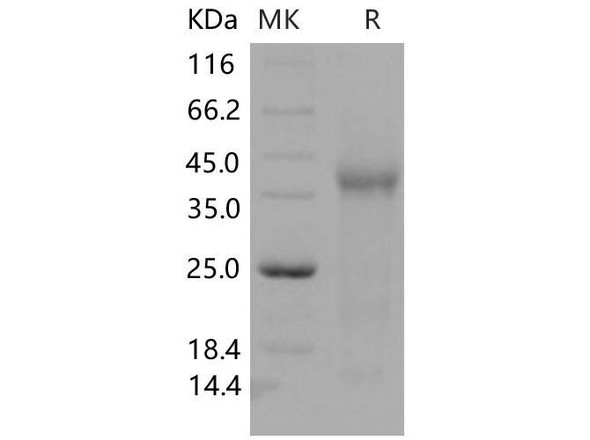
Mouse TGFBR3 Recombinant Protein (C-His) is a recombinant protein expressed in mammalian cells, spanning Met1-Thr785, with a C-terminal His tag. Predicted molecular weight: 88.18 kDa. Purity: >90% as determined by SDS-PAGE. Supplied lyophilized from a solution in PBS pH 7.4, 1 mM EDTA, 4% Trehalose, 1% Mannitol. Applications: ELISA, immunogen, SDS-PAGE and Western blot. Transforming growth factor beta receptor type 3 is a ~93 kDa protein. Cell surface receptor that regulates diverse cellular processes including cell proliferation, differentiation, migration, and apoptosis. For research use only.
Initiates BMP, inhibin, and TGF-beta signaling pathways by interacting with different ligands including TGFB1, BMP2, BMP5, BMP7 or GDF5. Alternatively, acts as a cell surface coreceptor for BMP ligands, serving to enhance ligand binding by differentially regulating BMPR1A/ALK3 and BMPR1B/ALK6 receptor trafficking. Promotes epithelial cell adhesion, focal adhesion formation and integrin signaling during epithelial cell spreading on fibronectin. By interacting with the scaffolding protein beta-arrestin2/ARRB2, regulates migration or actin cytoskeleton and promotes the activation of CDC42 as well as the inhibition of NF-kappa-B.
| Product Name: | Mouse TGFBR3 Recombinant Protein (C-His) |
| SKU: | GXRP10507 |
| Size: | 50 µg, 100 µg, 1 mg |
| Species: | Mouse |
| Synonyms: | Betaglycan, TGF-beta receptor type 3, TGF-beta receptor type III, TGFBR3, TGFR-3, Transforming growth factor beta receptor III, Transforming growth factor beta receptor type 3 |
| Tag: | C-His |
| Expression Host: | Mammalian cells |
| Protein Length: | Met1-Thr785 |
| Calculated MW: | 88.18 kDa |
| UniProt: | O88393 |
| Applications: | ELISA, Immunogen, SDS-PAGE, WB |
| Purity: | >90% as determined by SDS-PAGE. |
| Form: | Lyophilized |
| Formulation: | Lyophilized from a solution in PBS pH 7.4, 1 mM EDTA, 4% Trehalose, 1% Mannitol. |
| Reconstitution: | Reconstitute in sterile water for a stock solution. A copy of datasheet will be provided with the products, please refer to it for details. |
| Storage: | Store at 2 to 8°C for frequent use. Store at -20 to -80°C for twelve months from the date of receipt. |
| Shipping: | In general, proteins are provided as lyophilized powder/frozen liquid. They are shipped out with dry ice/blue ice unless customers require otherwise. |
| Note: | For research use only |