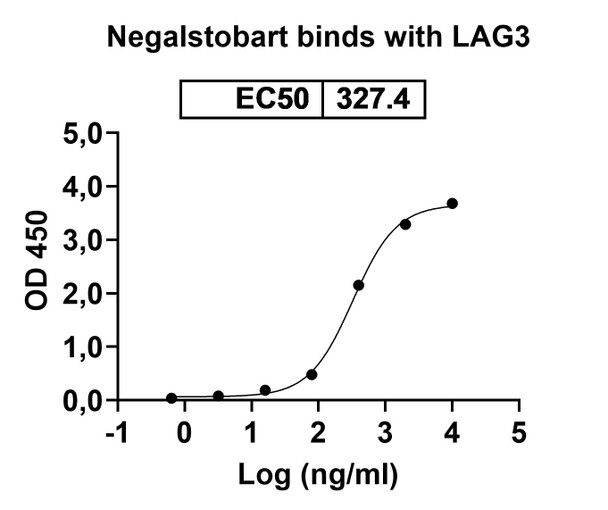
Negalstobart Antibody is a research-grade biosimilar monoclonal antibody targeting CD223. It is a human IgG4-kappa antibody. Reactivity: Human. Supplied as a liquid in 0.01M PBS pH 7.4. Applications: ELISA, flow cytometry, functional assays, in vivo research and Western blot. Endotoxin: < 10 EU/mg. Purity: >95% purity as determined by SDS-PAGE. For research use only.
Lymphocyte activation gene 3 protein (CD223/LAG3) is a ~57 kDa protein. Inhibitory receptor on antigen activated T-cells. Delivers inhibitory signals upon binding to ligands, such as MHC class II, its main ligand present at the surface of antigen-presenting cells (APCs), and FGL1, which is secreted by hepatocytes and certain types of tumor cells. Ligand-binding initiates a signaling that inhibits the T-cell receptor (TCR) in the immunological synapse, preventing T-cell activation. Mechanistically, ligand-binding promotes (1) ubiquitination of the KIEELE motif, unleashing the RRFSALE motif from the membrane and (2) leading to the formation of condensates with the TCR component CD3E, thereby disrupting the association between CD3E and LCK and preventing TCR activation. May inhibit antigen-specific T-cell activation in synergy with PDCD1/PD-1. CD223 is the therapeutic target of relatlimab (Opdualag).
Product Name:
Negalstobart Antibody
SKU:
GXBS02200
Size:
100 µg, 1 mg
Antibody Type:
Monoclonal Antibody
Target:
CD223
Isotype:
IgG4-kappa
Host Species:
Human
Reactivity:
Human
Applications:
ELISA, FCM, Functional assay, Research in vivo, WB
Synonyms:
2360418-68-2
Recommended Dilutions:
WB: 1:500-1:2000
Purity:
>95% as determined by SDS-PAGE.
Endotoxin Level:
< 10 EU/mg
Formulation:
0.01M PBS pH 7.4.
State of Matter:
Liquid
Regulatory Status:
For research use only. Not suitable for clinical or therapeutic use.
Product Preparation:
Protein A/G purified from cell culture supernatant.
Storage and Handling:
Store at 2 to 8°C for frequent use. Store at -20 to -80°C for twelve months from the date of receipt.