Description
Non-esterified Free Fatty Acids (NEFA) Colorimetric Assay Kit
The NEFA Colorimetric Assay Kit (MAES0026) quantifies non-esterified free fatty acids (NEFA) in animal tissue extracts by a copper soap colorimetric reaction read at 715 nm. The kit provides a 30 min endpoint assay with a 0.15–1.5 mmol/L detection range. Researchers use it to study lipid metabolism, lipolysis, and the relationship between NEFA levels and glucose metabolism and endocrine function.
Free fatty acids, also known as non-esterified fatty acids (NEFA), are derived from dietary sources and from the metabolism of adipose tissue. In adipose tissue, hormone-sensitive lipase (HSL) hydrolyzes triglycerides to produce glycerol and fatty acids. Circulating NEFA are bound to plasma albumin and are taken up by muscle, brain, and other tissues as an energy source.
NEFA are both products of fat hydrolysis and substrates for fat synthesis. NEFA concentration is related to lipid metabolism, glucose metabolism, and endocrine function, making it a useful readout in metabolic research on animal tissues.
| Product name: | Non-esterified Free Fatty Acids (NEFA) Colorimetric Assay Kit |
| SKU: | MAES0026 |
| Product size: | 96 Assays |
| Sample type: | Animal tissue |
| Detection method: | Colorimetric |
| Instrument: | Microplate reader (690–730 nm; optimum 715 nm) |
| Assay time: | 30 min |
| Research area: | Lipid metabolism; glycolysis and lipid metabolism; energy metabolism; metabolic diseases |
| Analyte: | Non-esterified free fatty acids (NEFA) |
| Sensitivity: | 0.15 mmol/L |
| Detection range: | 0.15–1.5 mmol/L |
| Intra-assay CV: | 3.3% |
| Inter-assay CV: | 5.1% |
| Recovery: | 101% |
| Measurement wavelength: | 715 nm (optimum); reader range 690–730 nm |
| Sample type: | Animal tissue (homogenate extract) |
| Assay time: | 30 min |
- Colorimetric endpoint read at 715 nm on a microplate reader (690–730 nm range)
- Detection range 0.15–1.5 mmol/L; sensitivity 0.15 mmol/L
- Validated for animal tissue homogenates (rat liver, heart, kidney; mouse liver)
- Intra-assay CV 3.3%; inter-assay CV 5.1%; recovery 101%
- Assay time 30 min; 96 Assays per kit
- Research Use Only
Under weakly acidic conditions, non-esterified free fatty acids react with nantokite to form copper soap, which has a specific absorption peak at 715 nm. NEFA content is calculated indirectly from the optical density (OD) measured at 715 nm, relative to a palmitic acid standard curve and a sample control.
- Quantification of NEFA in animal tissue homogenates in lipid metabolism studies
- Assessment of adipose-derived fatty acid release (lipolysis) in tissue models
- Investigation of links between NEFA levels and glucose metabolism or endocrine function
- Metabolic disease and energy metabolism research in rodent tissues
| Component | Quantity | Storage |
| Reagent 1: Extracting Solution | 60 mL × 2 vials (96 Assays) | 2–8 °C, 12 months; protect from light |
| Reagent 2: Palmitic Acid Standard (10 mmol/L) | 1 mL × 2 vials (96 Assays) | 2–8 °C, 12 months; protect from light |
| Reagent 3: Control Solution | 12 mL × 1 vial (96 Assays) | 2–8 °C, 12 months; protect from light |
| Reagent 4: Reaction Solution | 20 mL × 1 vial (96 Assays) | 2–8 °C, 12 months; protect from light |
| Microplate | 96 wells (96 Assays) | No requirement |
| Plate sealer | 2 pieces (96 Assays) | No requirement |
| Sample layout sheet | 1 piece (96 Assays) | No requirement |
- Microplate reader capable of 690–730 nm detection (715 nm optimum)
- Micropipettors
- Vortex mixer
- Oscillator or shaker capable of 4 °C operation
- Dounce homogenizer
- Refrigerated centrifuge capable of 10,000 × g at 4 °C
- Cold PBS (0.01 M, pH 7.4)
- Ice
- Normal saline (0.9% NaCl) or PBS (0.01 M, pH 7.4) for sample types not listed (pretest required)
Reagent and standard preparation
- Equilibrate Reagents 1–4 to room temperature before use.
- Prepare a fresh standard set for each assay; discard working standards after use.
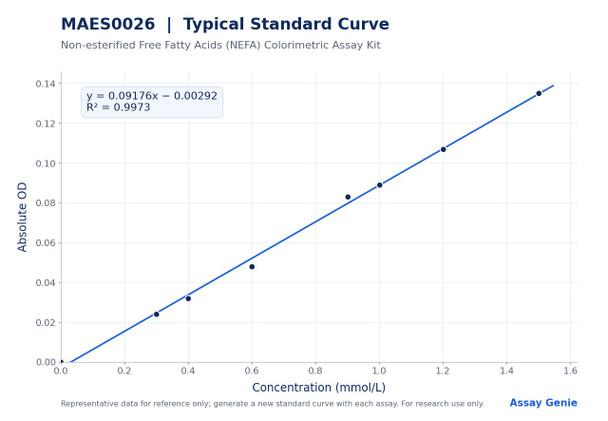
- Dilute the 10 mmol/L palmitic acid standard (Reagent 2) with Extracting Solution (Reagent 1) as follows: 0 mmol/L (0 µL standard + 1500 µL extracting solution); 0.3 mmol/L (45 µL + 1455 µL); 0.4 mmol/L (60 µL + 1440 µL); 0.6 mmol/L (90 µL + 1410 µL); 0.9 mmol/L (135 µL + 1365 µL); 1.0 mmol/L (150 µL + 1350 µL); 1.2 mmol/L (180 µL + 1320 µL); 1.5 mmol/L (225 µL + 1275 µL).