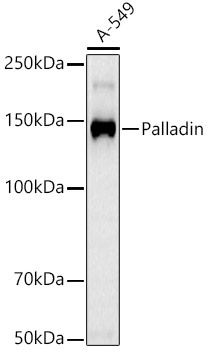
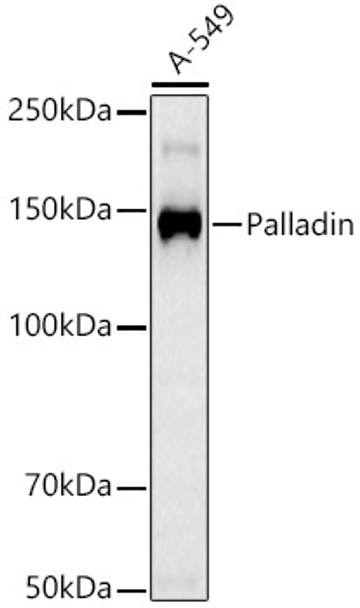
Western blot analysis of A-549, using Palladin Rabbit mAb (CAB23566) at 1:400 dilution. Secondary antibody: HRP Goat Anti-Rabbit IgG (H+L) at 1:10000 dilution. Lysates/proteins: 25μg per lane. Blocking buffer: 3% nonfat dry milk in TBST.
The Palladin Monoclonal Antibody (CAB23566) is a high-quality antibody developed for reliable detection and analysis of target proteins. This monoclonal antibody, generated through hybridoma technology, is highly reactive with human and mouse samples, making it versatile for various experimental applications.Palladin is a key player in cytoskeletal organization, cell migration, and cell adhesion, making it a crucial protein in understanding processes such as wound healing, cancer metastasis, and vascular development. The Palladin Monoclonal Antibody binds specifically to Palladin, allowing for precise detection and analysis in a wide range of cell types and tissues.
This antibody is validated for use in WB, ELISA applications and has demonstrated reactivity against Human samples.
Product Name:
Palladin Monoclonal Antibody
SKU:
CAB23566
Size:
20μL, 100μL
Reactivity:
Human
Clone Number:
ARC3132
Conjugate:
Unconjugated
Immunogen:
Recombinant protein (or fragment).This information is considered to be commercially sensitive.
This gene encodes a cytoskeletal protein that is required for organizing the actin cytoskeleton. The protein is a component of actin-containing microfilaments, and it is involved in the control of cell shape, adhesion, and contraction. Polymorphisms in this gene are associated with a susceptibility to pancreatic cancer type 1, and also with a risk for myocardial infarction. Alternative splicing results in multiple transcript variants.
Purification Method
Affinity purification
Gene ID
23022
Buffer Information
Store at -20℃. Avoid freeze / thaw cycles. Buffer: PBS containing 50% glycerol and 0.05% BSA, preserved with proclin300 or sodium azide, pH 7.3.
Western blot analysis of lysates from A-549 cells, using Palladin Rabbit mAb (CAB23566) at 1:400 dilution. Secondary antibody: HRP-conjugated Goat anti-Rabbit IgG (H+L) (CABS014) at 1:10000 dilution. Lysates/proteins: 25μg per lane. Blocking buffer: 3% nonfat dry milk in TBST. Detection: ECL Basic Kit (AbGn00020). Exposure time: 90s.


![Anti-Palladin [R76-6V-8] Monoclonal Antibody (AGMB03482)](https://cdn11.bigcommerce.com/s-h68l9z2lnx/images/stencil/590x590/products/274771/676918/anti-palladin-r76-6v-8-monoclonal-antibody-agmb03482__56955.1773030978.jpg?c=2 "Anti-Palladin [R76-6V-8] Monoclonal Antibody (AGMB03482)")