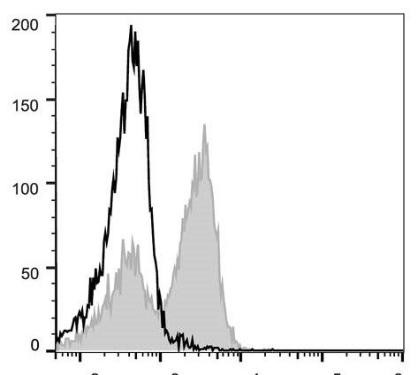
Description
PE Anti-Mouse CD3ε Antibody [145-2C11]
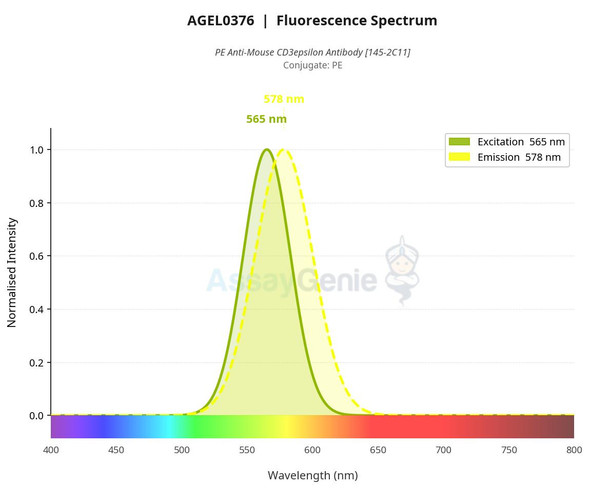
PE Anti-Mouse CD3ε Antibody [145-2C11] is a PE-conjugated armenian hamster monoclonal antibody (clone 145-2C11) against mouse CD3ε, for flow cytometry. PE is excited by the 488/561 nm laser.
CD3 is the signalling co-receptor complex of the T-cell receptor, made of epsilon, delta and gamma chains (CD3E, CD3D, CD3G), and is the standard pan-T-cell marker in flow cytometry.
Clone 145-2C11 is also available in 11 other formats: Purified, Biotin, GenieFluor Violet 450, FITC, GenieFluor 488, PerCP/Cyanine5.5, PE/Cyanine5, PE/Cyanine5.5, PE/Cyanine7, APC, GenieFluor 647. Compare every clone and colour on our CD3 antibodies for flow cytometry page.
| Product Title: | PE Anti-Mouse CD3ε Antibody [145-2C11] |
| SKU: | AGEL2202 |
| Size: | 25µg, 100µg |
| Clone No: | 145-2C11 |
| Synonyms: | T-cell surface glycoprotein CD3 epsilon chain;CD3E;T-cell surface antigen T3/Leu-4 epsilon chain;CD3e;CD3E;T3E; |
| Host Species: | Armenian Hamster |
| Reactivity: | Mouse |
| Application: | FCM |
| Isotype: | Armenian Hamster IgG |
| Isotype Control: | PE Armenian Hamster IgG Isotype Control[PIP] |
| Form: | Liquid |
| Conjugation: | PE |
| Recommended Use: | Each lot of this antibody is quality control tested by flow cytometric analysis. Please check your vial before the experiment. Since applications vary, the appropriate dilutions must be determined for individual use. We suggest each investigator should titrate the reagent to obtain optimal results [The recommended concentration is 0.1-1 μg/106 cells in 100 μL volume]. |
| Spectrum: |  |
| Swissprot: | P22646 |
| Gene ID: | 12501 |
| Storage Buffer: | Phosphate buffered solution, pH 7.2, containing 0.09% stabilizer and 1% protein protectant. |
| Stability & Storage: | Keep as concentrated solution. Store at 2~8°C and protected from prolonged exposure to light. Do not freeze. Centrifuge before opening to ensure complete recovery of vial contents. This product is guaranteed up to one year from purchase. |
| Background: | CD3ε is a 20 kD transmembrane protein, also known as CD3 or T3. It is a member of the Ig superfamily and primarily expressed on T cells, NK-T cells, and at different levels on thymocytes during T cell differentiation. CD3ε forms a TCR complex by associating with the CD3δ, γ and ζ chains, as well as the TCR α/β or γ/δ chains. CD3 plays a critical role in TCR signal transduction, T cell activation, and antigen recognition by binding the peptide/MHC antigen complex. |