The PE Anti-Rat CD3 Antibody (G4.18) is a crucial tool for immunology research, specifically targeting the CD3 antigen on rat T cells. This monoclonal antibody, offered by Assay Genie, is validated for use in flow cytometry applications and is highly specific in its binding to CD3, enabling precise detection and analysis of T cell populations.The CD3 antigen is a key component of the T cell receptor complex, essential for T cell activation and function in the immune response. By utilizing the PE Anti-Rat CD3 Antibody (G4.18), researchers can investigate T cell activation, proliferation, and functionality in various experimental settings.
This antibody is particularly valuable for studies involving T cell-mediated immune reactions, transplantation research, and autoimmune disease models.With its high specificity and reliability, the PE Anti-Rat CD3 Antibody (G4.18) from Assay Genie offers researchers a powerful tool to advance their understanding of T cell biology and immune responses in a rat model system. Its applications extend to a wide range of research areas, including immunology, oncology, and infectious diseases, providing valuable insights into T cell behavior and function.
Each lot of this antibody is quality control tested by flow cytometric analysis. Please check your vial before the experiment. Since applications vary, the appropriate dilutions must be determined for individual use. We suggest each investigator should titrate the reagent to obtain optimal results [The recommended concentration is 0.1-1 μg/106 cells in 100 μL volume].
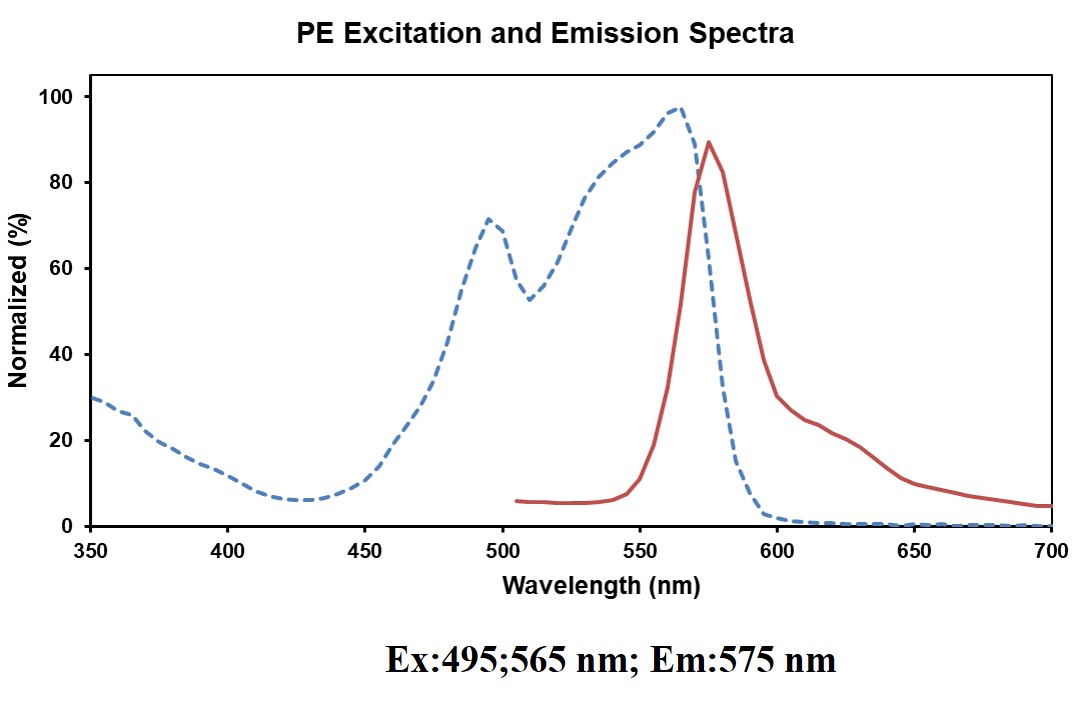
Spectrum:
Swissprot:
P19377 Q64159 D4A5M2
Gene ID:
25710,300678,315609,25300
Storage Buffer:
Phosphate buffered solution, pH 7.2, containing 0.09% stabilizer and 1% protein protectant.
Stability & Storage:
Keep as concentrated solution. Store at 2~8°C and protected from prolonged exposure to light. Do not freeze. Centrifuge before opening to ensure complete recovery of vial contents. This product is guaranteed up to one year from purchase.
Background:
CD3 is a complex composed of δ, γ, ε, and ζ chains. They are 20-25 kD members of the immunoglobulin superfamily and associated with the T cell receptor (TCR). CD3 is expressed on thymocytes, peripheral T cells, some NK-T cells, and dendritic epidermal T cells. CD3 is involved in antigen recognition, signal transduction, and T cell activation.

![PE Anti-Rat CD3 Antibody [G4.18] (AGEL2459)](https://cdn11.bigcommerce.com/s-h68l9z2lnx/images/stencil/1280x1280/products/229185/605247/pe-anti-rat-cd3-antibody-g4.18-agel2459__03448.1706889783.jpg?c=2?imbypass=on "PE Anti-Rat CD3 Antibody [G4.18] (AGEL2459)")
![PE Anti-Rat CD3 Antibody [G4.18] (AGEL2459)](https://cdn11.bigcommerce.com/s-h68l9z2lnx/images/stencil/608x608/products/229185/605247/pe-anti-rat-cd3-antibody-g4.18-agel2459__03448.1706889783.jpg?c=2 "PE Anti-Rat CD3 Antibody [G4.18] (AGEL2459)")
![PE Anti-Rat CD3 Antibody [G4.18] (AGEL2455)](https://cdn11.bigcommerce.com/s-h68l9z2lnx/images/stencil/590x590/products/229181/605181/pe-anti-rat-cd3-antibody-g4.18-agel2455__20574.1706889554.jpg?c=2 "PE Anti-Rat CD3 Antibody [G4.18] (AGEL2455)")
![PE/GenieFluor 594 Anti-Rat CD3 Antibody [G4.18] (AGEL3032)](https://cdn11.bigcommerce.com/s-h68l9z2lnx/images/stencil/590x590/products/229533/602058/pegeniefluor-594-anti-rat-cd3-antibody-g4.18-agel3032__75756.1706283531.jpg?c=2 "PE/GenieFluor 594 Anti-Rat CD3 Antibody [G4.18] (AGEL3032)")
![PE/GenieFluor 594 Anti-Rat CD3 Antibody [G4.18] (AGEL3033)](https://cdn11.bigcommerce.com/s-h68l9z2lnx/images/stencil/590x590/products/229534/602891/pegeniefluor-594-anti-rat-cd3-antibody-g4.18-agel3033__02037.1706286169.jpg?c=2 "PE/GenieFluor 594 Anti-Rat CD3 Antibody [G4.18] (AGEL3033)")
![FITC Anti-Rat CD3 Antibody [G4.18] (AGEL2458)](https://cdn11.bigcommerce.com/s-h68l9z2lnx/images/stencil/590x590/products/229184/605303/fitc-anti-rat-cd3-antibody-g4.18-agel2458__11347.1706890008.jpg?c=2 "FITC Anti-Rat CD3 Antibody [G4.18] (AGEL2458)")
![APC Anti-Rat CD3 Antibody [G4.18] (AGEL2460)](https://cdn11.bigcommerce.com/s-h68l9z2lnx/images/stencil/590x590/products/229186/604994/apc-anti-rat-cd3-antibody-g4.18-agel2460__53907.1706888957.jpg?c=2 "APC Anti-Rat CD3 Antibody [G4.18] (AGEL2460)")