The PE-Cyanine7 Anti-Human CD49d Antibody (HP1/2) from AssayGenie is a cutting-edge research tool designed for scientists studying cell adhesion and migration processes involving the CD49d molecule. This antibody, optimized for flow cytometry analysis, offers high specificity and sensitivity for detecting CD49d expression on human samples. By binding to CD49d, it allows precise identification and characterization of this integrin subunit in various cell types, facilitating detailed investigations in immunology, oncology, and inflammatory diseases.CD49d, a key component of integrin alpha-4 beta-1, plays a pivotal role in cell adhesion, migration, and signaling pathways.
Its involvement in immune cell trafficking and interactions with vascular endothelial cells makes it a crucial target for understanding immune responses, inflammation, and cancer metastasis. Researchers can leverage the PE-Cyanine7 Anti-Human CD49d Antibody (HP1/2) to delve deeper into the mechanisms underlying these biological processes, leading to potential therapeutic strategies aimed at modulating integrin-mediated functions for clinical benefit.
Each lot of this antibody is quality control tested by flow cytometric analysis. The amount of the reagent is suggested to be used 5 µL of antibody per test (million cells in 100 µL staining volume or per 100 µL of whole blood). Please check your vial before the experiment. Since applications vary, the appropriate dilutions must be determined for individual use.
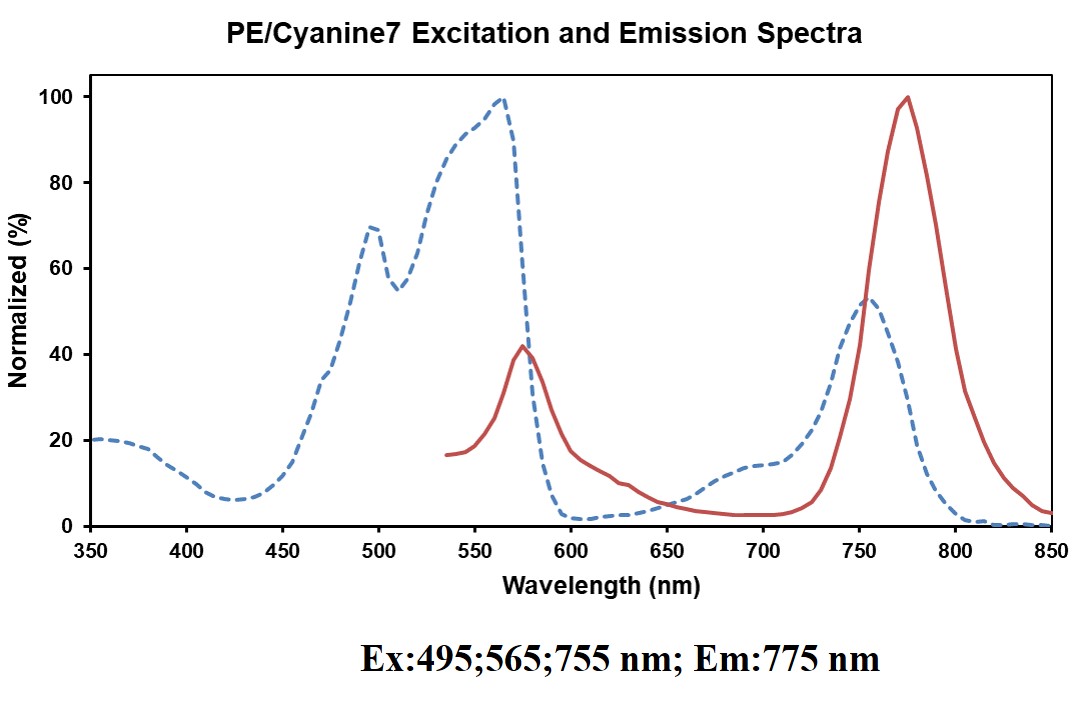
Spectrum:
Swissprot:
P13612
Gene ID:
3676
Storage Buffer:
Phosphate buffered solution, pH 7.2, containing 0.09% stabilizer and 1% protein protectant.
Stability & Storage:
Keep as concentrated solution. Store at 2~8°C and protected from prolonged exposure to light. Do not freeze. Centrifuge before opening to ensure complete recovery of vial contents. This product is guaranteed up to one year from purchase.
Background:
CD49d is a 150 kD α integrin chain known as α4 integrin or VLA-4 α chain. It forms a heterodimer with either integrin β1 (α4β1, VLA-4) or β7 (α4β7). CD49d is expressed broadly on T lymphocytes, B lymphocytes, monocytes, thymocytes, eosinophils, basophils, mast cells, NK cells, dendritic cells, and some non-hematopoietic cells, but not on normal red blood cells, platelets or neutrophils. VLA-4 binds to VCAM-1 (CD106) and fibronectin. α4β7 is the receptor for VCAM-1 and MAdCAM-1. CD49d participates in mononuclear cell trafficking to endothelial sites of inflammation and has roles in cell-cell interactions and cell adhesion to extracellular matrices. CD49d is involved in lymphocyte migration, T cell activation, and hematopoietic stem cell differentiation. CD49d is a marker to isolate pure populations of Treg cells due to its absence on Foxp3+ cells.

![PE/Cyanine7 Anti-Human CD49d Antibody [HP1/2] (AGEL3482)](https://cdn11.bigcommerce.com/s-h68l9z2lnx/images/stencil/1280x1280/products/221603/607215/pecyanine7-anti-human-cd49d-antibody-hp12-agel3482__54816.1707500465.jpg?c=2?imbypass=on "PE/Cyanine7 Anti-Human CD49d Antibody [HP1/2] (AGEL3482)")
![PE/Cyanine7 Anti-Human CD49d Antibody [HP1/2] (AGEL3482)](https://cdn11.bigcommerce.com/s-h68l9z2lnx/images/stencil/608x608/products/221603/607215/pecyanine7-anti-human-cd49d-antibody-hp12-agel3482__54816.1707500465.jpg?c=2 "PE/Cyanine7 Anti-Human CD49d Antibody [HP1/2] (AGEL3482)")
![PE Anti-Human CD49d Antibody [HP1/2] (AGEL3481)](https://cdn11.bigcommerce.com/s-h68l9z2lnx/images/stencil/590x590/products/221602/606649/pe-anti-human-cd49d-antibody-hp12-agel3481__27727.1707498681.jpg?c=2 "PE Anti-Human CD49d Antibody [HP1/2] (AGEL3481)")
![PE/Cyanine7 Anti-Human CD49d Antibody [9F10] (AGEL1741)](https://cdn11.bigcommerce.com/s-h68l9z2lnx/images/stencil/590x590/products/22272/606317/pecyanine7-anti-human-cd49d-antibody-9f10-agel1741__02114.1707497601.jpg?c=2 "PE/Cyanine7 Anti-Human CD49d Antibody [9F10] (AGEL1741)")
![FITC Anti-Human CD49d Antibody [HP1/2] (AGEL3480)](https://cdn11.bigcommerce.com/s-h68l9z2lnx/images/stencil/590x590/products/221601/606023/fitc-anti-human-cd49d-antibody-hp12-agel3480__46281.1707496736.jpg?c=2 "FITC Anti-Human CD49d Antibody [HP1/2] (AGEL3480)")
![Purified Anti-Human CD49d Antibody [HP1/2] (AGEL5119)](https://cdn11.bigcommerce.com/s-h68l9z2lnx/images/stencil/590x590/products/271123/692998/purified-anti-human-cd49d-antibody-hp12-agel5119__11611.1774507896.jpg?c=2 "Purified Anti-Human CD49d Antibody [HP1/2] (AGEL5119)")
![GenieFluor 700 Anti-Human CD49d Antibody [HP1/2] (AGEL4599)](https://cdn11.bigcommerce.com/s-h68l9z2lnx/images/stencil/590x590/products/270698/691211/geniefluor-700-anti-human-cd49d-antibody-hp12-agel4599__45274.1774502251.jpg?c=2 "GenieFluor 700 Anti-Human CD49d Antibody [HP1/2] (AGEL4599)")