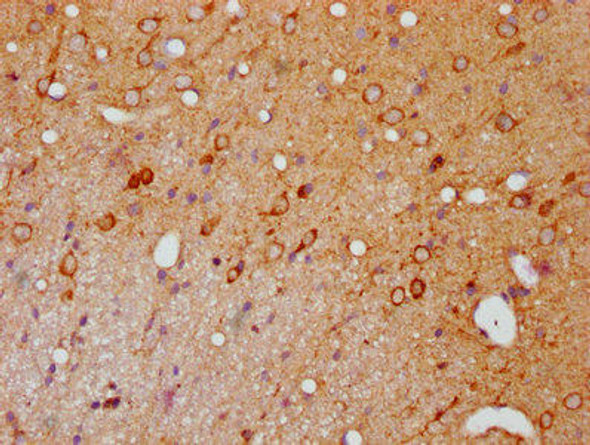
The Phospho-PAK2-S20 Monoclonal Antibody (CABP1443) is a high-quality antibody developed for reliable detection and analysis of target proteins. The antibody is designed to specifically target and detect phosphorylated PAK2 at serine 20, a critical site for regulating its activity.Raised in mice, this antibody is highly sensitive and specific for detecting phosphorylated PAK2 in human samples, making it a reliable tool for Western blot and immunofluorescence applications. By targeting the phosphorylated form of PAK2, researchers can gain insights into the activation status of this important signaling protein in various cell types and conditions.The phosphorylation of PAK2 at serine 20 has been linked to its role in regulating cytoskeletal dynamics, cell motility, and cell cycle progression.
This antibody is validated for use in WB, ELISA applications and has demonstrated reactivity against Mouse, Rat samples.
Product Name:
Phospho-PAK2-S20 Monoclonal Antibody
SKU:
CABP1443
Size:
20μL, 100μL
Reactivity:
Mouse, Rat
Clone Number:
ARC62567
Conjugate:
Unconjugated
Immunogen:
Synthetic peptide. This information is considered to be commercially sensitive.
Sequence:
MSST I
Tested Applications:
WBELISA
Recommended Dilution:
WB
1:1000 - 1:5000
ELISA
Recommended starting concentration is 1 μg/mL. Please optimize the concentration based on your specific assay requirements.
Synonyms:
KNO2, PAK65, PAKgamma, Phospho-PAK2-S20
Positive Sample:
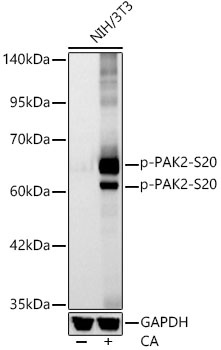
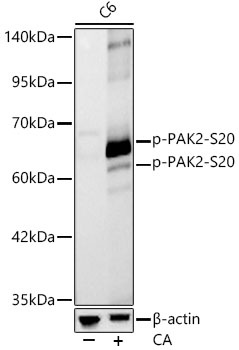
NIH/3T3 treated with Calyculin A, C6 treated with Calyculin A
Cellular Localization:
Cytoplasm, Membrane, Nucleus.
Calculated MW:
58kDa
Observed MW:
61kDa/67kDa
The p21 activated kinases (PAK) are critical effectors that link Rho GTPases to cytoskeleton reorganization and nuclear signaling. The PAK proteins are a family of serine/threonine kinases that serve as targets for the small GTP binding proteins, CDC42 and RAC1, and have been implicated in a wide range of biological activities. The protein encoded by this gene is activated by proteolytic cleavage during caspase-mediated apoptosis, and may play a role in regulating the apoptotic events in the dying cell.
Purification Method
Affinity purification
Gene ID
5062
Buffer Information
Store at -20℃. Avoid freeze / thaw cycles. Buffer: PBS containing 50% glycerol and 0.05% BSA, preserved with proclin300 or sodium azide, pH 7.3.
Western blot analysis of lysates from NIH/3T3 cells, using Phospho-PAK2-S20 Rabbit mAb (CABP1443) at 1:2000 dilution. NIH/3T3 cells were treated with Calyculin A (100 nM) at 37℃ for 30 minutes after serum-starvation overnight. Secondary antibody: HRP-conjugated Goat anti-Rabbit IgG (H+L) (CABS014) at 1:10000 dilution. Lysates/proteins: 25μg per lane. Blocking buffer: 3% nonfat dry milk in TBST. Detection: ECL Basic Kit (AbGn00020). Exposure time: 10s.
Western blot analysis of lysates from C6 cells, using Phospho-PAK2-S20 Rabbit mAb (CABP1443) at 1:2000 dilution. C6 cells were treated with Calyculin A (100 nM) at 37℃ for 30 minutes after serum-starvation overnight. Secondary antibody: HRP-conjugated Goat anti-Rabbit IgG (H+L) (CABS014) at 1:10000 dilution. Lysates/proteins: 25μg per lane. Blocking buffer: 3% nonfat dry milk in TBST. Detection: ECL Basic Kit (AbGn00020). Exposure time: 10s.




![Anti-PAK2 [R03-7C6] Monoclonal Antibody (AGMB00876)](https://cdn11.bigcommerce.com/s-h68l9z2lnx/images/stencil/590x590/products/272165/691684/anti-pak2-r03-7c6-monoclonal-antibody-agmb00876__33686.1774503800.jpg?c=2 "Anti-PAK2 [R03-7C6] Monoclonal Antibody (AGMB00876)")
![Anti-PAK2 (7H3) [7H3-E2-F5] Monoclonal Antibody (AGMB04244)](https://cdn11.bigcommerce.com/s-h68l9z2lnx/images/stencil/590x590/products/275533/677095/anti-pak2-7h3-7h3-e2-f5-monoclonal-antibody-agmb04244__91106.1773031476.jpg?c=2 "Anti-PAK2 (7H3) [7H3-E2-F5] Monoclonal Antibody (AGMB04244)")