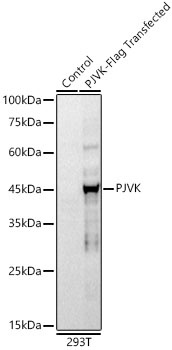
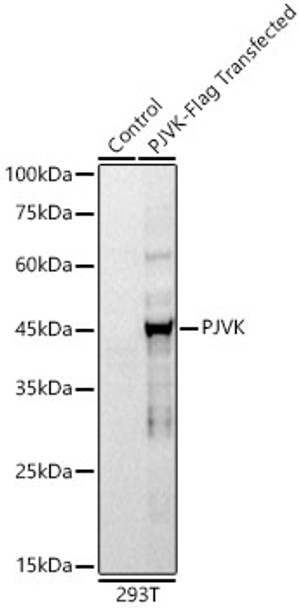
Western blot analysis of lysates from wild type (WT) and 293T cells transfected with PJVK, using PJVK Rabbit mAb (CAB23724) at 1:1000 dilution. Secondary antibody: HRP Goat Anti-Rabbit IgG (H+L) at 1:10000 dilution. Lysates/proteins: 25ug per lane. Blocking buffer: 3% nonfat dry milk in TBST.
The PJVK Monoclonal Antibody (CAB23724) is a high-quality antibody developed for reliable detection and analysis of target proteins. This monoclonal antibody, developed using cutting-edge technology, is highly specific and reactive with human samples, making it an ideal tool for various research applications.PJVK, also known as pejvakin, is a key player in the auditory system, playing a vital role in maintaining the health and function of hair cells in the inner ear. Mutations in the PJVK gene have been associated with progressive hearing loss and deafness, making it a target of interest for researchers in the field of otology and auditory science.
This antibody is validated for use in WB, ELISA applications and has demonstrated reactivity against Human samples.
Product Name:
PJVK Monoclonal Antibody
SKU:
CAB23724
Size:
20μL, 100μL
Reactivity:
Human
Clone Number:
ARC61181
Conjugate:
Unconjugated
Immunogen:
Recombinant protein (or fragment).This information is considered to be commercially sensitive.
Recommended starting concentration is 1 μg/mL. Please optimize the concentration based on your specific assay requirements.
Synonyms:
DFNB59, PJVK
Positive Sample:
293T-PJVK
Cellular Localization:
Peroxisome Membrane, Cilia.
Calculated MW:
40kDa
Observed MW:
45kDa(Full-lengthprotein)
The protein encoded by this gene is a member of the gasdermin family, a family which is found only in vertebrates. The encoded protein is required for the proper function of auditory pathway neurons. Defects in this gene are a cause of non-syndromic sensorineural deafness autosomal recessive type 59 (DFNB59).
Purification Method
Affinity purification
Gene ID
494513
Buffer Information
Store at -20℃. Avoid freeze / thaw cycles. Buffer: PBS containing 50% glycerol and 0.05% BSA, preserved with proclin300 or sodium azide, pH 7.3.
Western blot analysis of lysates from wild type (WT) and 293T cells transfected with PJVK, using PJVK Rabbit mAb (CAB23724) at 1:1000 dilution. Secondary antibody: HRP-conjugated Goat anti-Rabbit IgG (H+L) (CABS014) at 1:10000 dilution. Lysates/proteins: 25μg per lane. Blocking buffer: 3% nonfat dry milk in TBST. Detection: ECL Basic Kit (AbGn00020). Exposure time: 45s. WB samples for antibody validation are kindly provided by Dr. Feng Shao, NIBS