Major immune regulatory cytokine that acts on many cells of the immune system where it has profound anti- inflammatory functions, limiting excessive tissue disruption caused by inflammation. Mechanistically, IL10 binds to its heterotetrameric receptor comprising IL10RA and IL10RB leading to JAK1 and STAT2-mediated phosphorylation of STAT3. In turn, STAT3 translocates to the nucleus where it drives expression of anti-inflammatory mediators. Targets antigen-presenting cells (APCs) such as macrophages and monocytes and inhibits their release of pro-inflammatory cytokines including granulocyte-macrophage colony-stimulating factor /GM-CSF, granulocyte colony-stimulating factor/ G-CSF, IL-1 alpha, IL-1 beta, IL-6, IL-8 and TNF-alpha. Interferes also with antigen presentation by reducing the expression of MHC-class II and co-stimulatory molecules, thereby inhibiting their ability to induce T cell activation.In addition, controls the inflammatory response of macrophages by reprogramming essential metabolic pathways including mTOR signaling.
< 1.0 EU/mg of the protein as determined by the LAL method
Purity:
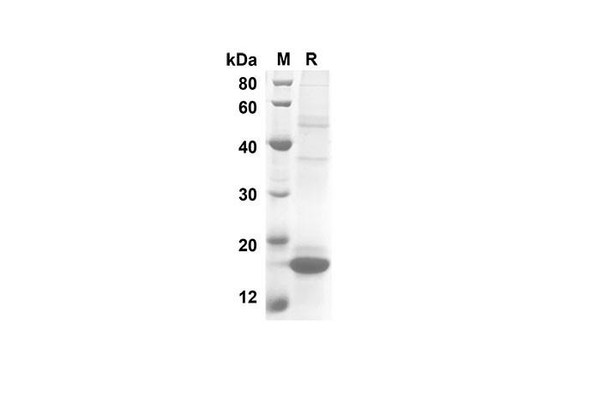
> 80% as determined by reducing SDS-PAGE.
Calculated MW:
17.6 kDa
Observed MW:
17 kDa
Bio-Activity:
Not validated for activity
Form:
Lyophilized powder
Source:
HEK293 Cells-derived Rabbit IL-10 protein Met1-Ser178, with an C-terminal His
Formulation:
Lyophilized from a 0.2 μm filtered solution in PBS with 5% Trehalose and 5% Mannitol.
Reconstitution:
It is recommended that sterile water be added to the vial to prepare a stock solution of 0.5 mg/mL. Concentration is measured by UV-Vis.
Storage:
Generally, lyophilized proteins are stable for up to 12 months when stored at -20 to - 80℃. Reconstituted protein solution can be stored at 4-8℃ for 2-7 days. Aliquots of reconstituted samples are stable at < -20℃ for 3 months.
Shipping:
This product is provided as lyophilized powder which is shipped with ice packs.