The RASA1 Monoclonal Antibody (CAB4876) is a high-quality antibody developed for reliable detection and analysis of target proteins. This antibody, produced through a monoclonal process, exhibits high specificity and sensitivity for detecting RASA1 protein in human samples, making it ideal for use in applications such as Western blotting and immunohistochemistry.RASA1, also known as p120RasGAP, acts as a negative regulator of Ras signaling, playing a key role in controlling cell growth, differentiation, and migration. Mutations in the RASA1 gene are associated with vascular disorders such as capillary malformation-arteriovenous malformation (CM-AVM) syndrome, highlighting its importance in vascular biology and disease.
This antibody is validated for use in WB, ELISA applications and has demonstrated reactivity against Human, Mouse samples.
Product Name:
RASA1 Monoclonal Antibody
SKU:
CAB4876
Size:
20μL, 100μL
Reactivity:
Human, Mouse
Clone Number:
ARC2730
Conjugate:
Unconjugated
Immunogen:
Synthetic peptide. This information is considered to be commercially sensitive.
Sequence:
KSGS YLIR ESDR RPGS FVLS FLSQ MNVV NHFR IIAM CGDY YIGG RRFS SLSD LIGY YSHV SCLL KGEK LLYP VAPP EPVE DRRR VRAI LPYT KVPD TDEI S
Tested Applications:
WBELISA
Recommended Dilution:
WB
1:100 - 1:500
ELISA
Recommended starting concentration is 1 μg/mL. Please optimize the concentration based on your specific assay requirements.
The protein encoded by this gene is located in the cytoplasm and is part of the GAP1 family of GTPase-activating proteins. The gene product stimulates the GTPase activity of normal RAS p21 but not its oncogenic counterpart. Acting as a suppressor of RAS function, the protein enhances the weak intrinsic GTPase activity of RAS proteins resulting in the inactive GDP-bound form of RAS, thereby allowing control of cellular proliferation and differentiation. Mutations leading to changes in the binding sites of either protein are associated with basal cell carcinomas. Mutations also have been associated with hereditary capillary malformations (CM) with or without arteriovenous malformations (AVM) and Parkes Weber syndrome. Alternative splicing results in two isoforms where the shorter isoform, lacking the N-terminal hydrophobic region but retaining the same activity, appears to be abundantly expressed in placental but not adult tissues.
Purification Method
Affinity purification
Gene ID
5921
Buffer Information
Store at -20℃. Avoid freeze / thaw cycles. Buffer: PBS containing 50% glycerol and 0.05% BSA, preserved with proclin300 or sodium azide, pH 7.3.
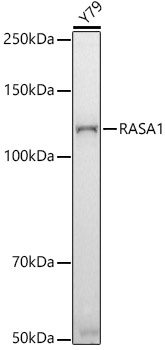
Western blot analysis of lysates from Y79 cells using RASA1 Rabbit mAb (CAB4876) at 1:500 dilution incubated overnight at 4°C. Secondary antibody: HRP-conjugated Goat anti-Rabbit IgG (H+L) (CABS014) at 1:10000 dilution. Lysates/proteins: 25μg per lane. Blocking buffer: 3% nonfat dry milk in TBST. Detection: ECL Basic Kit (AbGn00020). Exposure time: 90s.
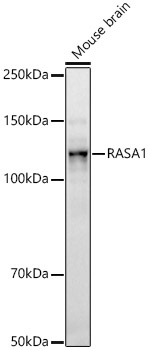
Western blot analysis of lysates from mouse brain using RASA1 Rabbit mAb (CAB4876) at 1:500 dilution incubated overnight at 4°C. Secondary antibody: HRP-conjugated Goat anti-Rabbit IgG (H+L) (CABS014) at 1:10000 dilution. Lysates/proteins: 25μg per lane. Blocking buffer: 3% nonfat dry milk in TBST. Detection: ECL Basic Kit (AbGn00020). Exposure time: 180s.



![Anti-RASA1 [R01-1D7] Monoclonal Antibody (AGMB02543)](https://cdn11.bigcommerce.com/s-h68l9z2lnx/images/stencil/590x590/products/273832/676437/anti-rasa1-r01-1d7-monoclonal-antibody-agmb02543__17534.1773029426.jpg?c=2 "Anti-RASA1 [R01-1D7] Monoclonal Antibody (AGMB02543)")