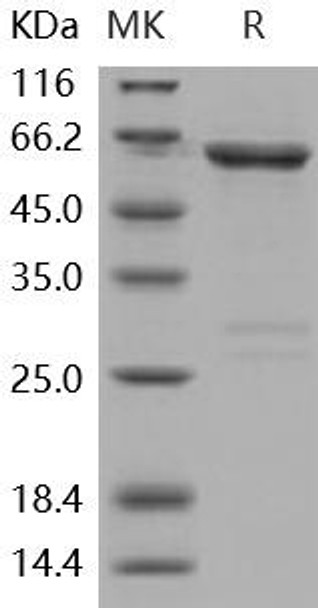
ACK1 (also known as ACK, TNK2, or activated Cdc42 kinase) is a structurally unique non-receptor tyrosine kinase that is expressed in diverse cell types. This downstream effector of CDC42 which mediates CDC42-dependent cell migration via phosphorylation of BCAR1. The ACK1 protein may be involved in a regulatory mechanism that sustains the GTP-bound active form of Cdc42Hs and which is directly linked to a tyrosine phosphorylation signal transduction pathway. ACK1 integrates signals from plethora of ligand-activated receptor tyrosine kinases (RTKs), for example, MERTK, EGFR, HER2 and PDGFR to initiate intracellular signaling cascades. It binds to both poly- and mono-ubiquitin and regulates ligand-induced degradation of EGFR. ACK1 transduces extracellular signals to cytosolic and nuclear effectors such as the protein kinase AKT/PKB and androgen receptor (AR), to promote cell survival and growth. ACK1 participates in tumorigenesis, cell survival, and migration. Gene amplification and overexpression of ACK1 were found in many cancer types such as those of the lung and prostate. Recently, four somatic missense mutations of ACK1, which occur in the N-terminal region, the C-lobe of the kinase domain, and the SH3 domain, were identified in cancer tissue samples.
Product Name:
Human ACK1/TNK2 Recombinant Protein (RPES2697)
Product Code:
RPES2697
Size:
50 µg
Species:
Human
Expressed Host:
Baculovirus-Insect Cells
Synonyms:
ACK,ACK-1,ACK1,p21cdc42Hs
Accession:
NP_005772.3
Sequence:
Gly 110-Trp 476
Fusion tag:
N-GST
Endotoxin:
<1.0 EU per µg as determined by the LAL method.
Protein Construction:
A DNA sequence encoding the amino acid (Gly 110-Trp 476) of human ACK1 isoform 1 (NP_005772.3) was expressed with the GST tag at the N-terminus.