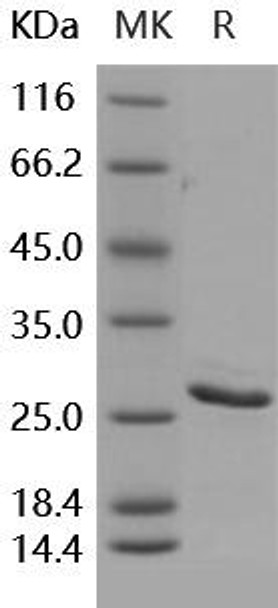
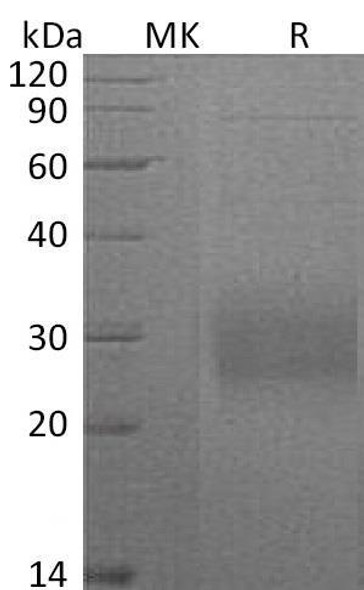
BCL2 (B-cell leukemia/lymphoma 2, N-Histidine-tagged), also known as Bcl-2, belongs to the Bcl-2 family. Bcl-2 family proteins regulate and contribute to programmed cell death or apoptosis. It is a large protein family and all members contain at least one of four BH (bcl-2 homology) domains. Certain members such as Bcl-2, Bcl-xl and Mcl1 are anti-apoptotic, whilst others are pro-apoptotic. Most Bcl-2 family members contain a C-terminal transmembrane domain that functions to target these proteins to the outer mitochondrial and other intracellular membranes. It is expressed in a variety of tissues. BCL2 blocks the apoptotic death of some cells such as lymphocytes. It also regulates cell death by controlling the mitochondrial membrane permeability and inhibits caspase activity either by preventing the release of cytochrome c from the mitochondria and/or by binding to the apoptosis-activating factor. Constitutive expression of BCL2, such as in the case of translocation of BCL2 to Ig heavy chain locus, is thought to be the cause of follicular lymphoma. Two transcript variants, produced by alternate splicing, differ in their C-terminal ends.Immune Checkpoint Immunotherapy Cancer Immunotherapy Targeted Therapy
Measured by its binding ability in a functional ELISA. Immobilized human BCL2-His at 10 µg/ml (100 ?l/well) can bind biotinylated mouse BCL2L1-His, The EC50 of biotinylated mouse BCL2L1-His is 0.07-0.15 µg/ml.
Endotoxin:
Please contact us for more information.
Protein Construction:
A DNA sequence encoding the human BCL2 isoform 1 (P10415-) (Met 1-Asp 211) was expressed, with a polyhistide tag at the C-terminus.
This product is provided as lyophilized powder which is shipped with ice packs.
Stability and Storage:
Lyophilized proteins are stable for up to 12 months when stored at -20 to -80°C. Reconstituted protein solution can be stored at 4-8°C for 2-7 days. Aliquots of reconstituted samples are stable at < -20°C for 3 months.