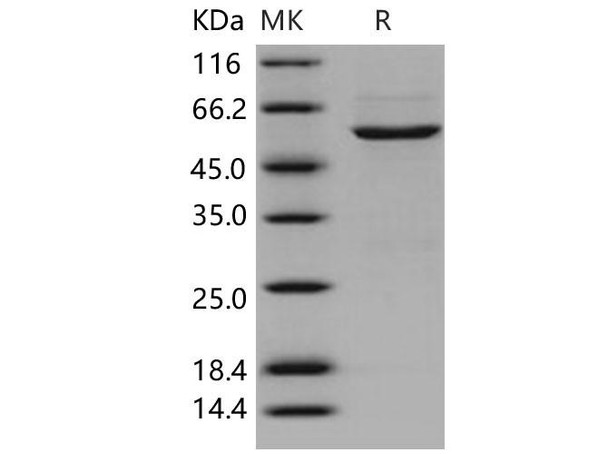
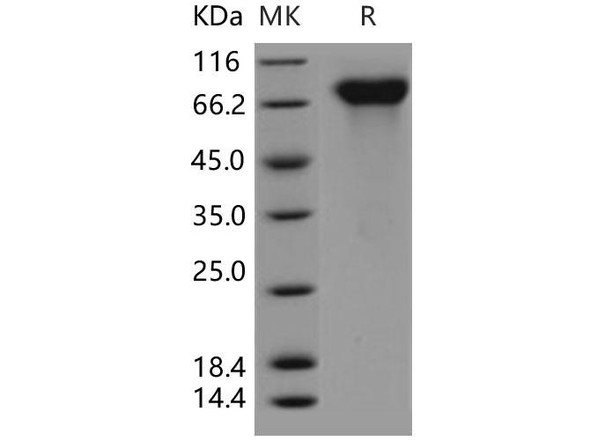
CDK4 is a member of the Ser/Thr protein kinase family. It is highly similar to the gene products of S. cerevisiae cdc28 and S. pombe cdc2. It is a catalytic subunit of the protein kinase complex that is important for cell cycle G1 phase progression. The activity of CDK4 is restricted to the G1-S phase, which is controlled by the regulatory subunits D-type cyclins and CDK inhibitor p16(INK4a). CDK4 was shown to be responsible for the phosphorylation of retinoblastoma gene product. CDK4 is the ser/Thr-kinase component of cyclin D-CDK4 (DC) complexes that phosphorylate and inhibit members of the retinoblastoma (RB) protein family including RB1 and regulate the cell-cycle during G(1)/S transition. Phosphorylation of RB1 allows dissociation of the transcription factor E2F from the RB/E2F complexes and the subsequent transcription of E2F target genes which are responsible for the progression through the G(1) phase. Hypophosphorylates RB1 in early G(1) phase. Cyclin D-CDK4 complexes are major integrators of various mitogenenic and antimitogenic signals. CDK4 has been shown to be mutated in some types of cancer, whilst a chromosomal rearrangement can lead to Cdk6 overexpression in lymphoma, leukemia and melanoma.
Product Name:
Human CDK4 Recombinant Protein (RPES1126)
Product Code:
RPES1126
Size:
50µg
Species:
Human
Expressed Host:
Baculovirus-Insect Cells
Synonyms:
CMM3,PSK-J3
Accession:
NP_000066.1
Sequence:
Met 1-Glu 303
Fusion tag:
N-GST
Endotoxin:
<1.0 EU per µg of the protein as determined by the LAL method.
Protein Construction:
A DNA sequence encoding the human CDK4 (NP_000066.1) (Met 1-Glu 303) was fused with the GST tag at the N-terminus.
This product is provided as lyophilized powder which is shipped with ice packs.
Stability and Storage:
Lyophilized proteins are stable for up to 12 months when stored at -20 to -80°C. Reconstituted protein solution can be stored at 4-8°C for 2-7 days. Aliquots of reconstituted samples are stable at < -20°C for 3 months.