Complexin-2 (CPLX2), a member of the complexin/synaphin family, is a soluble pre-synaptic protein believed to regulate neurotransmitter release from pre-synaptic terminals. Complexins are soluble proteins that regulate the activity of soluble N-ethylmaleimide-sensitive factor attachment protein receptor (SNARE) complexes necessary for vesicle fusion. Complexins are unable to bind to monomeric SNARE proteins but bind with high affinity to ternary SNARE complexes and with lower affinity to target SNARE complexes. Complexin 1 (CX1) and complexin 2 (CX2) are presynaptic proteins that modulate neurotransmitter release and are used as markers of inhibitory and excitatory synapses, respectively. CPLX2 is localized in pre-synaptic terminals in mature brain. The G71-P89 region of CPLX2 is essential and sufficient for preferential axonal distribution. CPLX2 participates in the Ca(2+)-sensitive regulatory pathway for zymogen granule exocytosis. Complexin-2 is a key player in normal neurological function, and its downregulation could lead to changes in neurotransmitter release sufficient to cause significant behavioural abnormalities such as depression. It is involved in synaptogenesis and the modulation of neurotransmitter release.
Product Name:
Human Complexin-2/CPLX2 Recombinant Protein (RPES4707)
Product Code:
RPES4707
Size:
100 µg
Species:
Human
Expressed Host:
E.coli
Synonyms:
921-L,CPX-2,CPX2,Hfb1
Accession:
Q6PUV4-1
Sequence:
Asp 2-Lys 134
Fusion tag:
N-His
Endotoxin:
Please contact us for more information.
Protein Construction:
A DNA sequence encoding the human CPLX2 (Q6PUV4-1) (Asp 2-Lys 134) was expressed, with a polyhistide tag at the N-terminus.
Purity:
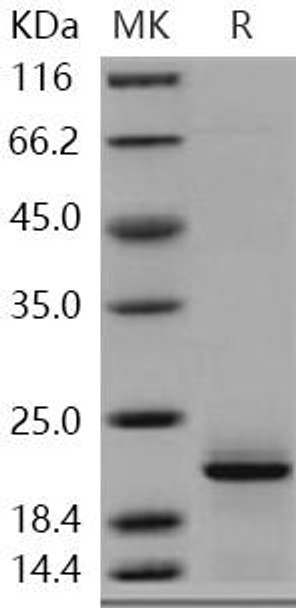
> 90 % as determined by reducing SDS-PAGE.
Mol Mass:
16.8 kDa
AP Mol Mass:
21 kDa
Formulation:
Lyophilized from sterile PBS, pH 7.4
Shipping:
This product is provided as lyophilized powder which is shipped with ice packs.
Stability and Storage:
Lyophilized proteins are stable for up to 12 months when stored at -20 to -80°C. Reconstituted protein solution can be stored at 4-8°C for 2-7 days. Aliquots of reconstituted samples are stable at < -20°C for 3 months.