Cellular repressor of E1A genes (CREG) is an evolutionarily conserved lysosomal protein, and an important new factor in regulating tissue homeostasis that has been shown to antagonize injury of tissues or cells. CREG contains three mannose 6-phosphate (M6P) markers, and depends on interactions with M6P receptors for efficient delivery to lysosomes, which is implicated in the regulation of lysosomal functions. This protein shares limited sequence similarity with E1A and binds both the general transcription factor TBP and the tumor suppressor pRb in vitro. CREG plays an important role in the control of cell growth and differentiation. It has been shown that CREG antagonizes transcriptional and cellular transformation by the adenoviral E1A oncoprotein, induces differentiation while attenuating cellular proliferation, regulates the levels of the signaling kinases ERK1/2, and mediates glucocorticoid-induced proliferation of ileal epithelial cells. CREG is widely expressed in adult tissues, such as the brain, heart, lungs, liver, intestines and kidneys in mice, but is not markedly expressed in pluripotent embryonic stem cells.
Product Name:
Human CREG/CREG1 Recombinant Protein (RPES3534)
Product Code:
RPES3534
Size:
10µg
Species:
Human
Expressed Host:
Human Cells
Synonyms:
CREG1, cellular repressor of E1A-stimulated genes, cellular repressor of E1A-stimulated genes 1CREG, protein CREG1
Accession:
O75629
Sequence:
Arg32-Gln220
Fusion tag:
C-His
Endotoxin:
<1.0 EU per µg as determined by the LAL method.
Protein Construction:
Recombinant Human CREG is produced by our Mammalian expression system and the target gene encoding Arg32-Gln220 is expressed with a 6His tag at the C-terminus.
Purity:
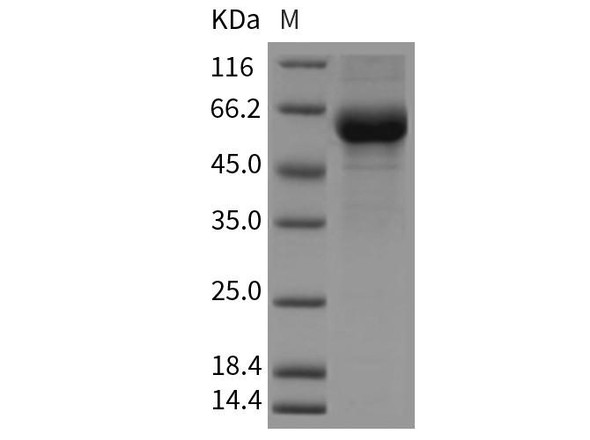
> 95% as determined by reducing SDS-PAGE.
Mol Mass:
21.9 kDa
AP Mol Mass:
20-38 kDa
Formulation:
Lyophilized from a 0.2 µm filtered solution of PBS,pH 7.4.
Shipping:
This product is provided as lyophilized powder which is shipped with ice packs.
Stability and Storage:
Lyophilized proteins are stable for up to 12 months when stored at -20 to -80°C. Reconstituted protein solution can be stored at 4-8°C for 2-7 days. Aliquots of reconstituted samples are stable at < -20°C for 3 months.