CD26 is a signal-anchor for type II membrane protein that belongs to the peptidase S9B family. CD26 is expressed specifically in lymphatic vessels but not in blood vessels in the skin; small intestine; esophagus; ovary; breast and prostate glands. It acts as a positive regulator of T-cell coactivation; by binding at least ADA; CAV1; IGF2R; and PTPRC. Its binding to CAV1 and CARD11 induces T-cell proliferation and NF-kappa-B activation in a T-cell receptor/CD3-dependent manner. Its interaction with ADA also regulates lymphocyte-epithelial cell adhesion. In association with FAP is involved in the pericellular proteolysis of the extracellular matrix (ECM); the migration and invasion of endothelial cells into the ECM. It may be involved in the promotion of lymphatic endothelial cells adhesion; migration and tube formation. When overexpressed; it enhanced cell proliferation; a process inhibited by GPC3. It acts also as a serine exopeptidase with a dipeptidyl peptidase activity that regulates various physiological processes by cleaving peptides in the circulation; including many chemokines; mitogenic growth factors; neuropeptides and peptide hormones.
Product Name:
Human DPP4/DPPIV/CD26 Recombinant Protein (RPES3052)
Product Code:
RPES3052
Size:
10µg
Species:
Human
Expressed Host:
Human Cells
Synonyms:
Dipeptidyl peptidase 4, ADABP, Adenosine deaminase complexing protein 2, ADCP-2, Dipeptidyl peptidase IV, DPP IV, T-cell activation antigen CD26
Accession:
P27487
Sequence:
Asn29-Pro766
Fusion tag:
C-His
Endotoxin:
<1.0 EU per µg as determined by the LAL method.
Protein Construction:
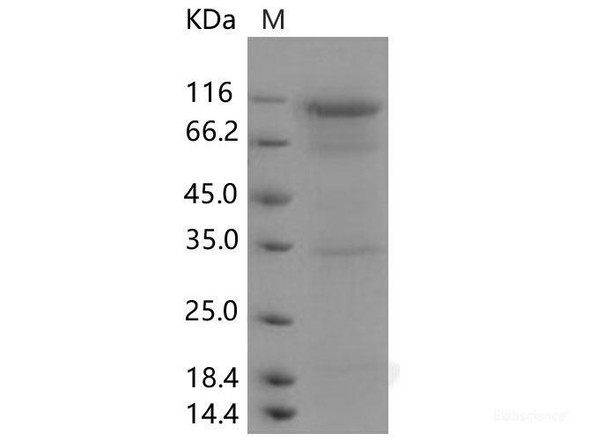
Recombinant Human DPP4 is produced by our Mammalian expression system and the target gene encoding Asn29-Pro766 is expressed with a 6His tag at the C-terminus.
Purity:
> 95% as determined by reducing SDS-PAGE.
Mol Mass:
86.4 kDa
AP Mol Mass:
90-130 kDa
Formulation:
Lyophilized from a 0.2 µm filtered solution of PBS; pH 7.4.
Shipping:
This product is provided as lyophilized powder which is shipped with ice packs.
Stability and Storage:
Lyophilized proteins are stable for up to 12 months when stored at -20 to -80°C. Reconstituted protein solution can be stored at 4-8°C for 2-7 days. Aliquots of reconstituted samples are stable at < -20°C for 3 months.