Ephrin-B1 also known as EFNB1, is a member of the ephrin family. The transmembrane- associated ephrin ligands and their Eph family of receptor tyrosine kinases are expressed by cells of the SVZ. Eph/ephrin interactions are implicated in axon guidance, neural crest cell migration, establishment of segmental boundaries, and formation of angiogenic capillary plexi. Eph receptors and ephrins are divided into two subclasses, A and B, based on binding specificities. Ephrin subclasses are further distinguished by their mode of attachment to the plasma membrane: ephrin-A ligands bind EphA receptors and are anchored to the plasma membrane via a glycosylphosphatidylinositol (GPI) linkage, whereas ephrin-B ligands bind EphB receptors and are anchored via a transmembrane domain. An exception is the EphA4 receptor, which binds both subclasses of ephrins. EphrinB1 and B class Eph receptors provide positional cues required for the normal morphogenesis of skeletal elements. Another malformation, preaxial polydactyly, was exclusively seen in heterozygous females in which expression of the X-linked ephrinB1 gene was mosaic, so that ectopic EphB-ephrinB1 interactions led to restricted cell movements and the bifurcation of digital rays.
Product Name:
Human Ephrin-B1/EFNB1 Recombinant Protein (RPES0174)
Measured by its binding ability in a functional ELISA. Immobilized mouse EphB3 at 2 µg/ml (100 ?l/well) can bind human EFNB1 Fc chimera with a linear ranger of 1.56-25 ng/ml.
Endotoxin:
<1.0 EU per µg as determined by the LAL method.
Protein Construction:
A DNA sequence encoding the human EFNB1 (NP_004420.1) extracellular domain (Met 1-Gly 232) was was fused with the C-terminal polyhistidine-tagged Fc region of human IgG1 at the C-terminus.
Purity:
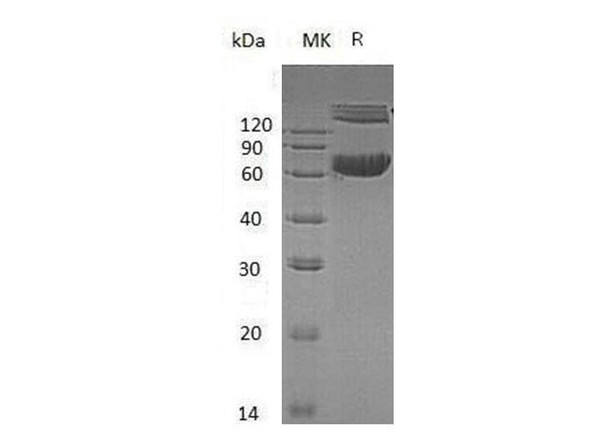
>(79.7+18.0) % as determined by reducing SDS-PAGE.
Mol Mass:
51.2 kDa
AP Mol Mass:
64 and 36 kDa
Formulation:
Lyophilized from sterile PBS, pH 7.4
Shipping:
This product is provided as lyophilized powder which is shipped with ice packs.
Stability and Storage:
Lyophilized proteins are stable for up to 12 months when stored at -20 to -80°C. Reconstituted protein solution can be stored at 4-8°C for 2-7 days. Aliquots of reconstituted samples are stable at < -20°C for 3 months.