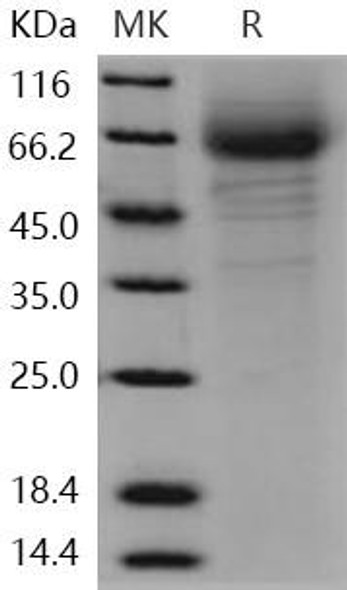
The three fibronectin leucine-rich repeat transmembrane (FLRT) proteins contain 10 leucine-rich repeats (LRR), a type III fibronectin (FN) domain, followed by the transmembrane region, and a short cytoplasmic tail. FLRT1 is expressed in kidney and brain, which is a target for tyrosine phosphorylation mediated by FGFR1 and implicate a non-receptor Src family kinase (SFK). All FLRTs can interact with FGFR1 and FLRTs can be induced by the activation of FGF signalling by FGF-2. The phosphorylation state of FLRT1, which is itself FGFR1 dependent, may play a critical role in the potentiation of FGFR1 signalling and may also depend on a SFK-dependent phosphorylation mechanism acting via the FGFR. This is consistent with an 'in vivo' role for FLRT1 regulation of FGF signalling via SFKs. Furthermore, the phosphorylation-dependent futile cycle mechanism controlling FGFR1 signalling is concurrently crucial for regulation of FLRT1-mediated neurite outgrowth. FLRT1, FLRT2 and FLRT3 are members of the fibronectin leucine rich transmembrane protein (FLRT) family. They may function in cell adhesion and/or receptor signalling. Their protein structures resemble small leucine-rich proteoglycans found in the extracellular matrix. FLRT3 shares 55% amino acid sequence identity with FLRT1.
Product Name:
Human FLRT1 Recombinant Protein (RPES1714)
Product Code:
RPES1714
Size:
100 µg
Species:
Human
Expressed Host:
HEK293 Cells
Synonyms:
Leucine-Rich Repeat Transmembrane Protein FLRT1, Fibronectin-Like Domain-Containing Leucine-Rich Transmembrane Protein 1, FLRT1
Accession:
Q9NZU1-1
Sequence:
Met 1-Pro 524
Fusion tag:
C-His
Activity:
Measured by the ability of the immobilized protein to support the adhesion of Neuro?2A mouse neuroblastoma cells.When cells are added to coated plates(5µg/mL, 100?L/well), approximately 50%-70% will adhere after 1 hour at 37?.
Endotoxin:
<1.0 EU per µg as determined by the LAL method.
Protein Construction:
A DNA sequence encoding the human FLRT1 extracellular domain (Q9NZU1-1) (Met 1-Pro 524) was expressed, fused with a polyhistidine tag at the C-terminus.
Purity:
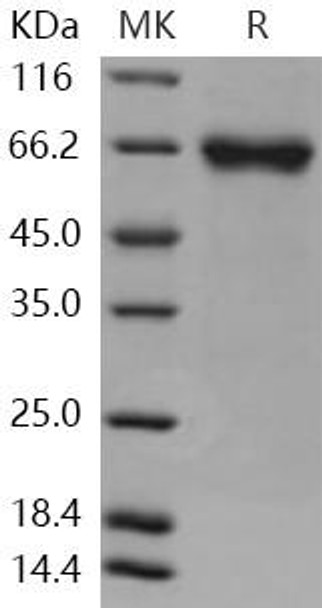
> 96 % as determined by reducing SDS-PAGE.
Mol Mass:
57 kDa
AP Mol Mass:
65 kDa
Formulation:
Lyophilized from sterile PBS, pH 7.4
Shipping:
This product is provided as lyophilized powder which is shipped with ice packs.
Stability and Storage:
Lyophilized proteins are stable for up to 12 months when stored at -20 to -80°C. Reconstituted protein solution can be stored at 4-8°C for 2-7 days. Aliquots of reconstituted samples are stable at < -20°C for 3 months.