Nucleophosmin 1 (NPM1), also known as nucleolar phosphoprotein B23 or numatrin, is a member of the nucleoplasmin family. Nucleophosmin (NPM) is a nucleolar phosphoprotein that plays multiple roles in ribosome assembly and transport, cytoplasmic-nuclear trafficking, centrosome duplication and regulation of p53. The NPM1 gene is frequently involved in chromosomal translocation, mutation and deletion. Mutations of the NPM1 gene leading to the expression of a cytoplasmic mutant protein, NPMc+, are the most frequent genetic abnormalities found in acute myeloid leukemias. Acute myeloid leukemias (AML) with mutated NPM1 have distinct characteristics, including a significant association with a normal karyotype, involvement of different hematopoietic lineages, a specific gene-expression profile and clinically, a better response to induction therapy and a favorable prognosis. In addition, NPM1 is a crucial gene to consider in the context of the genetics and biology of cancer. NPM1 is frequently overexpressed, mutated, rearranged and deleted in human cancer. Traditionally regarded as a tumour marker and a putative proto-oncogene, it has now also been attributed with tumour-suppressor functions.
Product Name:
Human NPM1/Nucleophosmin Recombinant Protein (RPES0528)
Product Code:
RPES0528
Size:
100 µg
Species:
Human
Expressed Host:
E.coli
Synonyms:
B23,NPM
Accession:
P06748-1
Sequence:
Met 9-Leu 158
Fusion tag:
N-His
Endotoxin:
Please contact us for more information.
Protein Construction:
A DNA sequence encoding the human NPM1 isoform 1 (P06748-1) N-terminal segment (Met 9-Leu 158) was expressed, with a polyhistide tag at the N-terminus.
Purity:
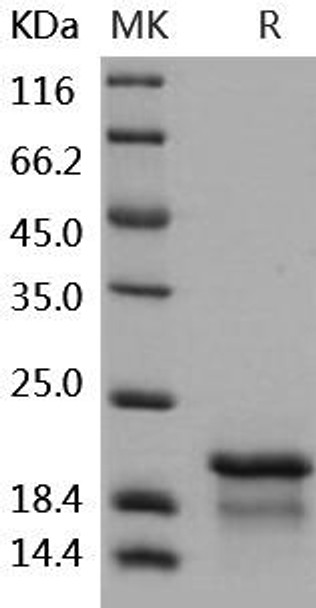
> 90 % as determined by reducing SDS-PAGE.
Mol Mass:
17.8 kDa
AP Mol Mass:
20 kDa
Formulation:
Lyophilized from sterile PBS, pH 6.0
Shipping:
This product is provided as lyophilized powder which is shipped with ice packs.
Stability and Storage:
Lyophilized proteins are stable for up to 12 months when stored at -20 to -80°C. Reconstituted protein solution can be stored at 4-8°C for 2-7 days. Aliquots of reconstituted samples are stable at < -20°C for 3 months.