Neuroendocrine convertase 1, also known as Prohormone convertase 1, Proprotein convertase 1, PCSK1 and NEC1, is an enzyme which belongs to the peptidase S8 family and Furin subfamily. PCSK1 is an enzyme that performs the proteolytic cleavage of prohormones to their intermediate (or sometimes completely cleaved) forms. It is present only in neuroendocrine cells such as brain, pituitary and adrenal, and most often cleaves after a pair of basic residues within prohormones but can occasionally cleave after a single arginine. It binds to a protein known as proSAAS, which also represents its endogenous inhibitor. PCSK1 is involved in the processing of hormone and other protein precursors at sites comprised of pairs of basic amino acid residues. PCSK1 substrates include POMC, renin, enkephalin, dynorphin, somatostatin and insulin. Defects in PCSK1 are the cause of proprotein convertase 1 deficiency (PC1 deficiency). PC1 deficiency is characterized by obesity, hypogonadism, hypoadrenalism, reactive hypoglycemia as well as marked small-intestinal absorptive dysfunction. It is due to impaired processing of prohormones.
Product Name:
Human PCSK1/NEC1 Recombinant Protein (RPES1635)
Product Code:
RPES1635
Size:
10µg
Species:
Human
Expressed Host:
HEK293 Cells
Synonyms:
BMIQ12,NEC1,PC1,PC3,SPC3
Accession:
NP_000430.3
Sequence:
Met 1-Arg 617
Fusion tag:
C-His
Endotoxin:
<1.0 EU per µg as determined by the LAL method.
Protein Construction:
A DNA sequence encoding the human PCSK1 (NP_000430.3) (Met 1-Arg 617) was fused with a polyhistidine tag at the C-terminus.
Purity:
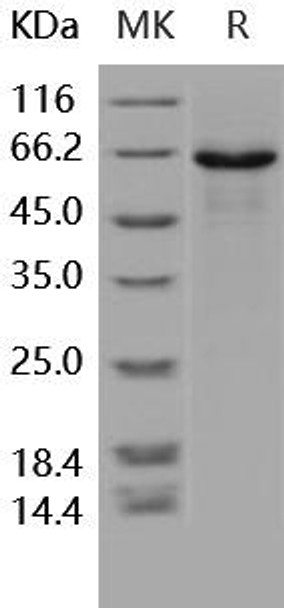
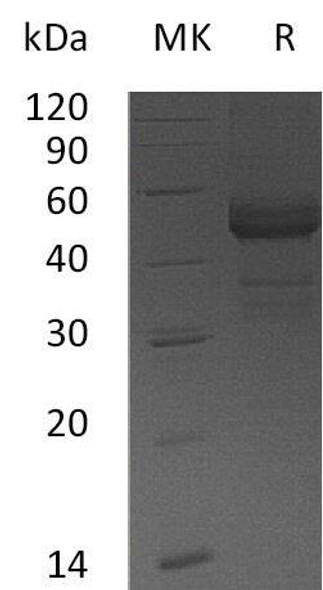
> 95 % as determined by reducing SDS-PAGE.
Mol Mass:
57.4 kDa
AP Mol Mass:
66 kDa
Formulation:
Lyophilized from sterile 25mM Tris, 150mM NaCl, pH 7.5
Shipping:
This product is provided as lyophilized powder which is shipped with ice packs.
Stability and Storage:
Lyophilized proteins are stable for up to 12 months when stored at -20 to -80°C. Reconstituted protein solution can be stored at 4-8°C for 2-7 days. Aliquots of reconstituted samples are stable at < -20°C for 3 months.