The human Polymeric Immunoglobulin Receptor (pIgR) is a 100 kDa type I transmembrane glycoprotein. Its precursor is 764 amino acids. It contains an 18 amino acid signal sequence, a 620 amino acid extracellular region, a 23 amino acid transmembrane fragment, and a 103 amino acid cytoplasmic domain. pIgR is synthesized by secretory epithelial cells with five Ig-like domains in extracellular region, and transfer to the basolateral plasma membrane. For IgA and IgM polymers, in addition to ?-heavy chains and light Ig chains, a short polypeptide named joining chain (J chain) is also contained and required. pIgR can bind larger polymers of IgA (pIgA) and pentameric IgM as a carrier that transports IgA and IgM across epithelium. The receptor-ligand complexes are endocytosed and transcytosed to the apical surface, then proteolytic cleavage of the sixth extracellular domain of pIgR and generate secretory IgA (SIgA), the pIgR fragment is referred to as secretory component (SC). SIgA is a important component of the mucosal immune system. SC is anti-microbial properties and protects SIgA from proteolytic degradation
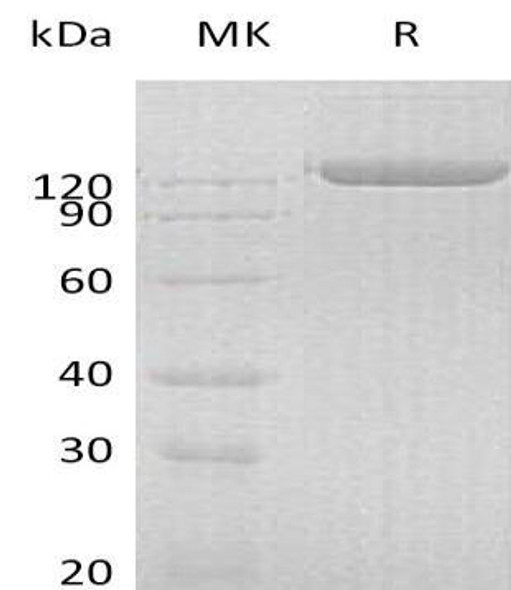
Recombinant Human Polymeric Immunoglobulin Receptor is produced by our Mammalian expression system and the target gene encoding Lys19-Arg638 is expressed with a 6His tag at the C-terminus.
Purity:
> 95 % as determined by reducing SDS-PAGE.
Mol Mass:
68.9 kDa
AP Mol Mass:
88 kDa
Formulation:
Lyophilized from a 0.2 µm filtered solution of 20mM PB, 150mM NaCl, pH 7.2.
Shipping:
This product is provided as lyophilized powder which is shipped with ice packs.
Stability and Storage:
Lyophilized proteins are stable for up to 12 months when stored at -20 to -80°C. Reconstituted protein solution can be stored at 4-8°C for 2-7 days. Aliquots of reconstituted samples are stable at < -20°C for 3 months.