SLITRK1 (Slit and Trk-like family member 1) is a integral membrane protein belonging to the SLITRK family consists of at least 6 members (SLITRK1-6). They are named and characterized by the presence of two leucine-rich repeats (LRRs) in the extracellular domain similar to those found in a secreted axonal growth-controlling protein; Slit; as well as a C-terminal domain with homology to Trk neurotrophin tyrosine kinase receptors. Expression of SLITRKs are highly restricted to neural tissues; and are identified as the neuronal components modulating the neurite outgrowth. More specifically; SLITRK1 expression is found in the mature neurons of the cerebrum; thalamus and hippocampus; and induces unipolar neurites in cultured neuronal cells. Human SLITRK1 is a 696 amino acid precursor protein; and one truncating frameshift mutation (448 aa) has been linked to Tourette's syndrome; a genetically influenced developmental neuropsychiatric disorder characterized by chronic vocal and motor tics. In addition; all SLITRK genes are differentially expressed in brain tumors; such as astrocytoma; oligodendroglioma; glioblastoma; and are suggested to be useful molecular indicators of brain tumor properties.
A DNA sequence encoding the extracellular domain (Met 1-Ser 616) of human SLITRK1 (NP_443142.1) was expressed with a C-terminal polyhistidine tag.
Purity:
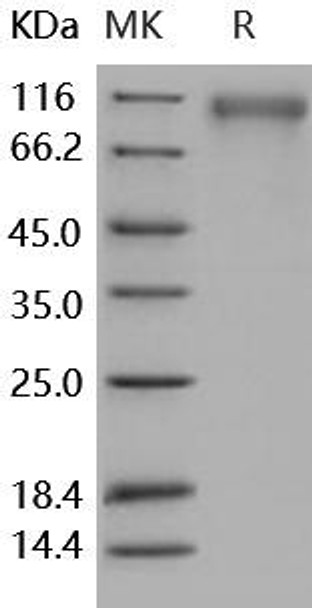
> 95 % as determined by reducing SDS-PAGE.
AP Mol Mass:
105-115 kDa
Formulation:
Lyophilized from sterile PBS; pH 7.4
Shipping:
This product is provided as lyophilized powder which is shipped with ice packs.
Stability and Storage:
Lyophilized proteins are stable for up to 12 months when stored at -20 to -80°C. Reconstituted protein solution can be stored at 4-8°C for 2-7 days. Aliquots of reconstituted samples are stable at < -20°C for 3 months.