STAT1 is a member of the STAT protein family. In response to cytokines and growth factors; STAT family members are phosphorylated by the receptor associated kinases; and then form homo- or heterodimers that translocate to the cell nucleus where they act as transcription activators. STAT1 can be activated by various ligands; including interferon-alpha; interferon-gamma; EGF; PDGF and IL6. It is a signal transducer and transcription activator that mediates cellular responses to interferons (IFNs); cytokine KITLG/SCF and other cytokines and growth factors. The phosphorylated STATs dimerize; associate with ISGF3G/IRF-9 to form a complex termed ISGF3 transcription factor; that enters the nucleus. ISGF3 binds to the IFN stimulated response element (ISRE) to activate the transcription of interferon stimulated genes; which drive the cell in an antiviral state. In response to type II IFN (IFN-gamma); STAT1 is tyrosine- and serine-phosphorylated. It then forms a homodimer termed IFN-gamma-activated factor (GAF); migrates into the nucleus and binds to the IFN gamma activated sequence (GAS) to drive the expression of the target genes; inducing a cellular antiviral state. STAT1 becomes activated in response to KITLG/SCF and KIT signaling and may mediate cellular responses to activated FGFR1; FGFR2; FGFR3 and FGFR4. Defects in STAT1 can cause STAT1 deficiency complete and familial candidiasis type 7.
Product Name:
Human STAT1 Recombinant Protein (RPES1911)
Product Code:
RPES1911
Size:
100 µg
Species:
Human
Expressed Host:
Baculovirus-Insect Cells
Synonyms:
Signal Transducer and Activator of Transcription 1-Alpha/Beta, Transcription Factor ISGF-3 Components p91/p84, STAT1, CANDF7,IMD31A,IMD31B,IMD31C,ISGF-3,STAT91
Accession:
P42224-2
Sequence:
Met 1-Val 712
Fusion tag:
N-His-GST
Endotoxin:
<1.0 EU per µg of the protein as determined by the LAL method.
Protein Construction:
A DNA sequence encoding the human STAT1 isoform beta (P42224-2) (Met 1-Val 712) was fused with the N-terminal polyhistidine-tagged GST tag at the N-terminus.
Purity:
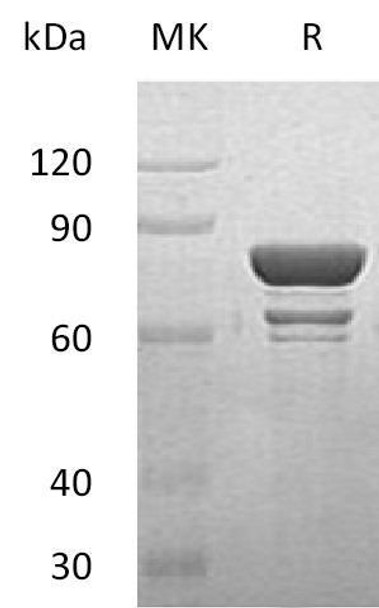
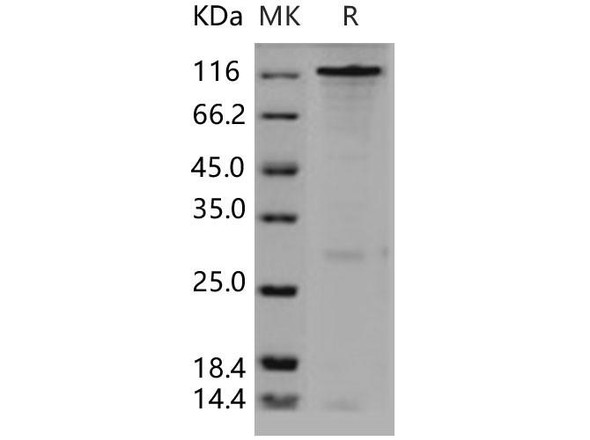
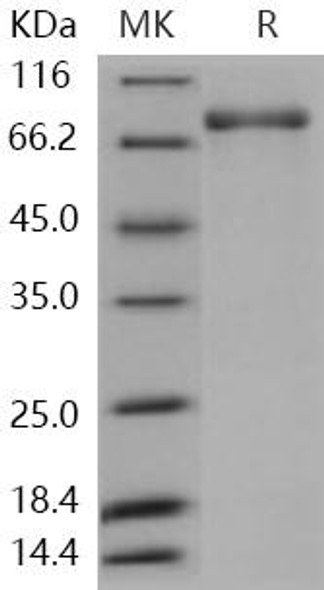
> 92 % as determined by reducing SDS-PAGE.
Mol Mass:
111 kDa
AP Mol Mass:
105 kDa
Formulation:
Lyophilized from sterile 20mM Tris; 500mM NaCl; pH 7.4
Shipping:
This product is provided as lyophilized powder which is shipped with ice packs.
Stability and Storage:
Lyophilized proteins are stable for up to 12 months when stored at -20 to -80°C. Reconstituted protein solution can be stored at 4-8°C for 2-7 days. Aliquots of reconstituted samples are stable at < -20°C for 3 months.