Small Ubiquitin-Related Modifier 1 (SUMO1) is an Ubiquitin-like protein that belongs to the ubiquitin family with SUMO subfamily. It is a family of small, related proteins that can be enzymatically attached to a target protein by a post-translational modification process termed sumoylation. SUMO1 functions in a manner similar to ubiquitin in that it is bound to target proteins as part of a post-translational modification system. This post-translational modification on lysine residues of proteins plays a crucial role in a number of cellular processes such as nuclear transport, DNA replication and repair, mitosis and signal transduction. SUMO1 is involved in a variety of cellular processes, such as nuclear transport, transcriptional regulation, apoptosis, and protein stability. SUMO1 is not active until the last four amino acids of the carboxy-terminus are cleaved off. Polymeric SUMO1 chains are also susceptible to polyubiquitination which functions as a signal for proteasomal degradation of modified proteins and may also regulate a network of genes involved in palate development.
Product Name:
Human SUMO1 Recombinant Protein (RPES1690)
Product Code:
RPES1690
Size:
10µg
Species:
Human
Expressed Host:
E.coli
Synonyms:
Small Ubiquitin-Related Modifier 1, SUMO-1, GAP-Modifying Protein 1, GMP1, SMT3 Homolog 3, Sentrin, Ubiquitin-Homology Domain Protein PIC1, Ubiquitin-Like Protein SMT3C, Smt3C, Ubiquitin-Like Protein,UBL1, SUMO1, SMT3C, SMT3H3, UBL1,DAP1,OFC10,SENP2,SMT3
Accession:
P63165
Sequence:
Met 1-Val101
Fusion tag:
N-6His
Endotoxin:
<1.0 EU per µg as determined by the LAL method.
Protein Construction:
Recombinant Human Small Ubiquitin-Related Modifier 1 is produced by our E.coli expression system and the target gene encoding Met1-Val101 is expressed with a 6His tag at the N-terminus.
Purity:
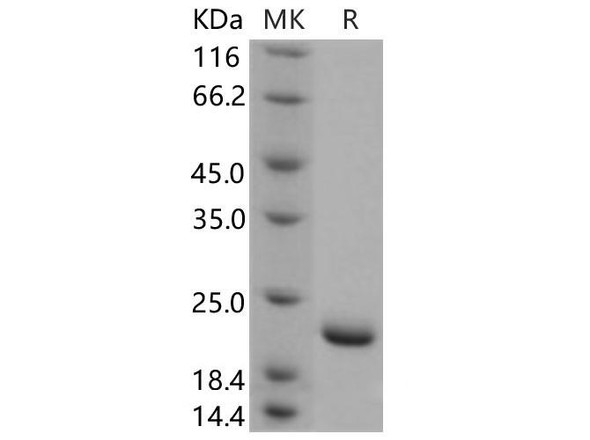
> 90 % as determined by reducing SDS-PAGE.
Mol Mass:
13.7 kDa
AP Mol Mass:
17-19 kDa
Formulation:
Lyophilized from a 0.2 µm filtered solution of 50mM TrisHCl, 100mM NaCl, 1mM DTT, pH 8.5 .
Shipping:
This product is provided as lyophilized powder which is shipped with ice packs.
Stability and Storage:
Lyophilized proteins are stable for up to 12 months when stored at -20 to -80°C. Reconstituted protein solution can be stored at 4-8°C for 2-7 days. Aliquots of reconstituted samples are stable at < -20°C for 3 months.