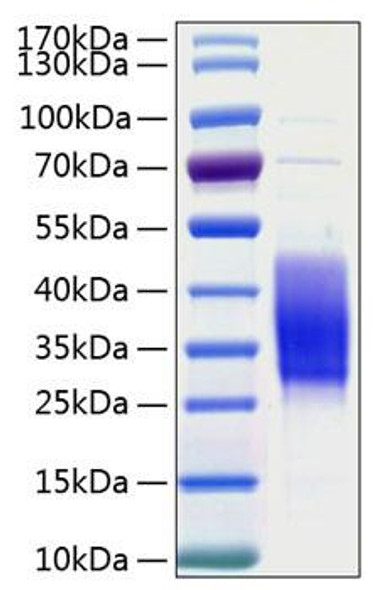
Hepatitis A virus cellular receptor 2 (HAVCR2) is a single-pass type I membrane protein and it contains 1 Ig-like V-type (immunoglobulin-like) domain. The protein belongs to the immunoglobulin superfamily; and TIM family of proteins. The protein regulates macrophage activation. It inhibits T-helper type 1 lymphocyte (Th1)-mediated auto- and alloimmune responses and promotes immunological tolerance. It may be also involved in T-cell homing and it is receptor for LGALS9. CD4 (MIM 186940)-positive T helper lymphocytes can be divided into types 1 (Th1) and 2 (Th2) on the basis of their cytokine secretion patterns. Th1 cells and their associated cytokines are involved in cell-mediated immunity to intracellular pathogens and delayed-type hypersensitivity reactions; whereas Th2 cells are involved in the control of extracellular helminthic infections and the promotion of atopic and allergic diseases. The 2 types of cells also cross-regulate the functions of the other. TIM3 is a Th1-specific cell surface protein that regulates macrophage activation and enhances the severity of experimental autoimmune encephalomyelitis in mice.
Product Name:
Human TIM-3/HAVCR2 Recombinant Protein (RPES5056)
Product Code:
RPES5056
Size:
10µg
Species:
Human
Expressed Host:
Human Cells
Synonyms:
Hepatitis A virus cellular receptor 2, HAVcr-2, T-cell immunoglobulin and mucin domain-containing protein 3, TIMD-3, T-cell immunoglobulin mucin receptor 3, TIM-3, T-cell membrane protein 3, HAVCR2, TIM3, TIMD3
Accession:
Q8TDQ0
Sequence:
Ser22-Arg200(Arg140Leu)
Fusion tag:
C-mFc
Endotoxin:
<1.0 EU per µg as determined by the LAL method.
Protein Construction:
Recombinant Human TIM-3 is produced by our Mammalian expression system and the target gene encoding Ser22-Arg200(Arg140Leu) is expressed with a mFc tag at the C-terminus.
Purity:
> 80% as determined by reducing SDS-PAGE.
Mol Mass:
46.4 kDa
AP Mol Mass:
55 kDa
Formulation:
Lyophilized from a 0.2 µm filtered solution of PBS; pH 7.4.
Shipping:
This product is provided as lyophilized powder which is shipped with ice packs.
Stability and Storage:
Lyophilized proteins are stable for up to 12 months when stored at -20 to -80°C. Reconstituted protein solution can be stored at 4-8°C for 2-7 days. Aliquots of reconstituted samples are stable at < -20°C for 3 months.