Tumor necrosis factor receptor superfamily, member 10a (TRAIL R1), also known as TRAIL receptor 1 (TRAIL R1) or CD261 antigen, is a member of the TNF-receptor superfamily. This receptor is activated by tumor necrosis factor-related apoptosis inducing ligand (TNFSF10/TRAIL), and thus transduces cell death signal and induces cell apoptosis. Studies with FADD-deficient mice suggested that FADD, a death domain containing adaptor protein, is required for the apoptosis mediated by this protein. TRAIL R1/CD261/TNFRSF10A serves as a receptor for the cytotoxic ligand TNFSF10/TRAIL. The adapter molecule FADD recruits caspase-8 to the activated receptor. The resulting death-inducing signaling complex (DISC) performs caspase-8 proteolytic activation which initiates the subsequent cascade of caspases (aspartate-specific cysteine proteases) mediating apoptosis. TRAIL R1 can promote the activation of NF-kappa-B. TRAIL R1/CD261/TNFRSF10A induces apoptosis of many transformed cell lines but not of normal tissues, even though its death domain-containing receptor, DR4, is expressed on both cell types.Immune Checkpoint Immunotherapy Cancer Immunotherapy Targeted Therapy
Product Name:
Human TRAILR1/TNFRSF10A Recombinant Protein (RPES3477)
Product Code:
RPES3477
Size:
100µg
Species:
Human
Expressed Host:
HEK293 Cells
Synonyms:
APO2,CD261,DR4,MGC9365,TNFRSF10A,TRAILR-1,TRAILR1
Accession:
NP_003835.2
Sequence:
Met 1-Asn 239
Fusion tag:
C-His
Activity:
Measured by its ability to inhibit TRAIL-mediated cytotoxicity using L?929 mouse fibroblast cells treated with TRAIL.The ED50 for this effect is typically 50-200 ng/ml in the presence of 20 ng/ml Recombinant Human TRAIL/TNFSF10.
Endotoxin:
<1.0 EU per µg as determined by the LAL method.
Protein Construction:
A DNA sequence encoding the human TNFRSF10A (NP_003835.2) extracellular domain (Met 1-Asn 239) was expressed, fused with a polyhistidine tag at the C-terminus.
Purity:
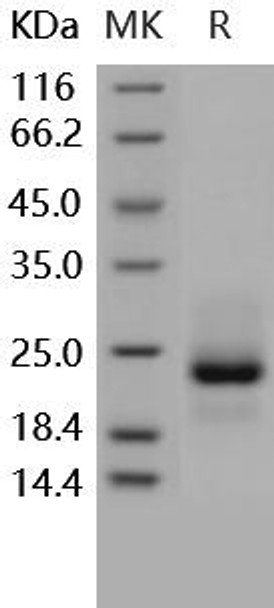
> 92 % as determined by reducing SDS-PAGE.
Mol Mass:
15.7 kDa
AP Mol Mass:
24 kDa
Formulation:
Lyophilized from sterile PBS, pH 7.4
Shipping:
This product is provided as lyophilized powder which is shipped with ice packs.
Stability and Storage:
Lyophilized proteins are stable for up to 12 months when stored at -20 to -80°C. Reconstituted protein solution can be stored at 4-8°C for 2-7 days. Aliquots of reconstituted samples are stable at < -20°C for 3 months.