Ubiquitin carboxyl-terminal hydrolase 5, also known as Deubiquitinating enzyme 5, Isopeptidase T, Ubiquitin thiolesterase 5, Ubiquitin-specific-processing protease 5, ISOT and USP5, is a member of the peptidase C19 family. USP5 contains 2 UBA domains and one UBP-type zinc finger. The UBP-type zinc finger domain interacts selectively with an unmodified C-terminus of the proximal ubiquitin. Both UBA domains are involved in polyubiquitin recognition. The UBP-type zinc finger domain crystallizes as a dimer linked by a disulfide bond between the Cys-195 residues of both molecules, but there is no evidence that the full-length USP5 exists as a dimer. USP5 cleaves linear and branched multiubiquitin polymers with a marked preference for branched polymers. USP5 is involved in unanchored 'Lys-48'-linked polyubiquitin disassembly. It binds linear and 'Lys-63'-linked polyubiquitin with a lower affinity. Knock-down of USP5 causes the accumulation of p53/TP53 and an increase in p53/TP53 transcriptional activity because the unanchored polyubiquitin that accumulates is able to compete with ubiquitinated p53/TP53 but not with MDM2 for proteasomal recognition.
Product Name:
Human USP5/ISOT Recombinant Protein (RPES4801)
Product Code:
RPES4801
Size:
50µg
Species:
Human
Expressed Host:
Baculovirus-Insect Cells
Synonyms:
ISOT
Accession:
P45974-2
Sequence:
Met 1-Ser 835
Fusion tag:
C-His
Endotoxin:
<1.0 EU per µg as determined by the LAL method.
Protein Construction:
A DNA sequence encoding the human USP5 isoform short (P45974-2) (Met 1-Ser 835) was fused with a polyhistidine tag at the C-terminus.
Purity:
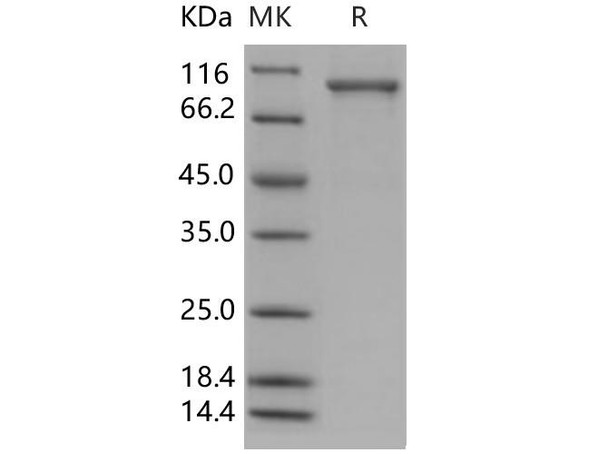
> 92 % as determined by reducing SDS-PAGE.
Mol Mass:
94.7 kDa
AP Mol Mass:
100 kDa
Formulation:
Lyophilized from sterile 50mM Tris, 100mM NaCl, pH 7.4
Shipping:
This product is provided as lyophilized powder which is shipped with ice packs.
Stability and Storage:
Lyophilized proteins are stable for up to 12 months when stored at -20 to -80°C. Reconstituted protein solution can be stored at 4-8°C for 2-7 days. Aliquots of reconstituted samples are stable at < -20°C for 3 months.