ALK-2, also termed as ACVR1, was initially identified as an activin type I receptor because of its ability to bind activin in concert with ActRII or ActRIIB. ALK-2 is also identified as a BMP type I receptor. It has been demonstrated that ALK-2 forms complex with either the BMP-2/7-bound BMPR-II or ACVR2A /ACVR2B. ALK-1 and ALK-2 presenting in the yeast Saccharomyces cerevisiae are two haspin homologues. Both ALK-1 and ALK-2 exhibit a weak auto-kinase activity in vitro, and are phosphoproteins in vivo. ALK-1 and ALK-2 levels peak in mitosis and late-S/G2. Control of protein stability plays a major role in ALK-2 regulation. The half-life of ALK-2 is particularly short in G1. Overexpression of ALK-2, but not of ALK-1, causes a mitotic arrest, which is correlated to the kinase activity of the protein. This suggests a role for ALK-2 in the control of mitosis. Endoglin is phosphorylated on cytosolic domain threonine residues by the TGF-beta type I receptors ALK-2 and ALK-5 in prostate cancer cells. Endoglin did not inhibit cell migration in the presence of constitutively active ALK-2. Defects in ALK-2 are a cause of fibrodysplasia ossificans progressiva (FOP).
Measure by its ability to bind with human BMP2 in a functional ELISA.
Endotoxin:
<1.0 EU per µg of the protein as determined by the LAL method.
Protein Construction:
A DNA sequence encoding the mouse ACVR1 (NP_031420.2) precursor (Met 1-Glu 123) was fused with the C-terminal polyhistidine-tagged Fc region of human IgG1 at the C-terminus.
Purity:
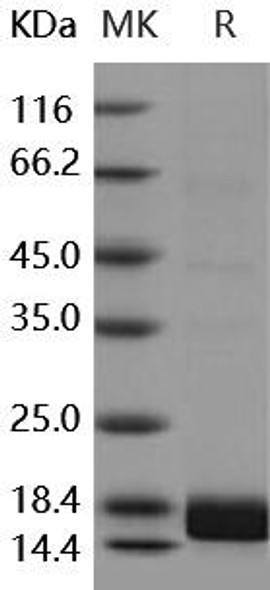
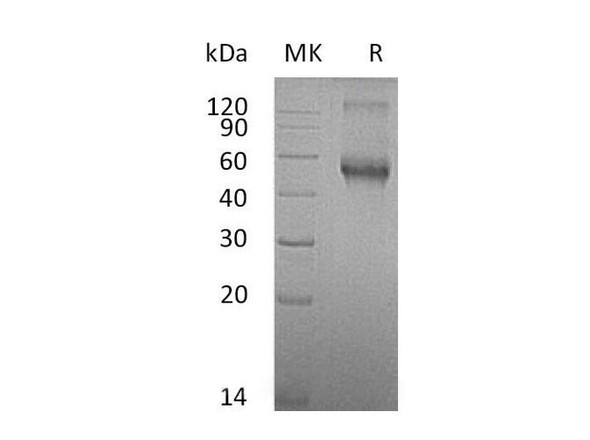
> 90 % as determined by SDS-PAGE
Mol Mass:
40 kDa
AP Mol Mass:
45 kDa
Formulation:
Lyophilized from sterile PBS, pH 7.4
Shipping:
This product is provided as lyophilized powder which is shipped with ice packs.
Stability and Storage:
Lyophilized proteins are stable for up to 12 months when stored at -20 to -80°C. Reconstituted protein solution can be stored at 4-8°C for 2-7 days. Aliquots of reconstituted samples are stable at < -20°C for 3 months.