Programmed cell death 1 ligand 2 (PD-L2), also known as butyrophilin B7-DC or PDCD1 ligand 2, belongs to the member of B7 family which can regulate the activation and tolerance of T cells. PD-L2 is one ligand for Programmed cell death 1(PD-1), and the other is PD-L1. These two ligands shares 34% aa sequence identity. Mouse PD-L2 gene encodes a 273 amino acids (aa) protein with a putative 19 aa signal peptide, a 201 aa extracellular region , a 21 aa transmembrane domain and a 32 aa cytoplasmic region. The mouse PD-L2 gene is highly expressed in heart, placenta, pancreas, lung and liver while expressed weakly in spleen, lymph nodes and thymus. Besides, the expression of PD-L2 gene can be induced on dendritic cells grown from peripheral blood mononuclear cells under CSF2 and IL4/interleukin-4 treatment, and up-regulated by IFNG/IFN-gamma stimulation in monocytes. PD-L2 usually functions in a PDCD1-independent manner and is involved in regulating costimulatory signal which is essential for T-cell proliferation and IFNG production. Recent studies demonstrate that the expression of PD-L2 on the tumor cells promotes CD8 T cellmediated rejection of tumor cells, at both the induction and effector phase of antitumor immunity. Moreover, PD-L2 binds to PD-1 cells and enhances T cell killing in a PD-1independent mechanism.
Product Name:
Mouse B7-DC/PD-L2/CD273 Recombinant Protein (RPES0850)
Recombinant Mouse PD-L2 is produced by our Mammalian expression system and the target gene encoding Leu20-Arg219 is expressed with a Fc tag at the C-terminus.
Purity:
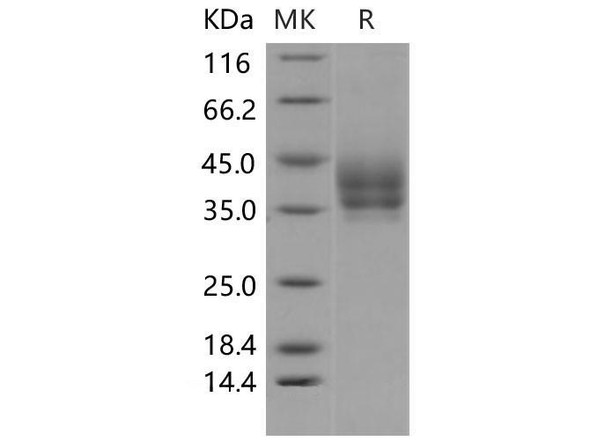
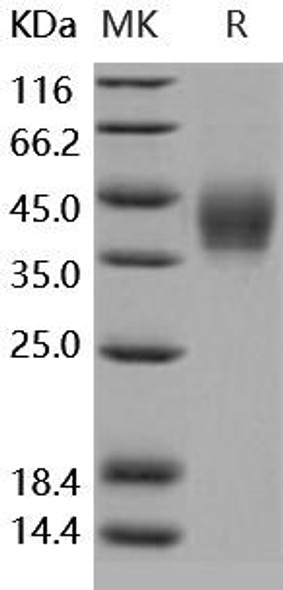
> 95% as determined by reducing SDS-PAGE.
Mol Mass:
49.7 kDa
AP Mol Mass:
70-80 kDa
Formulation:
Lyophilized from a 0.2 µm filtered solution of 20mM PB, 150mM NaCl, pH 7.4.
Shipping:
This product is provided as lyophilized powder which is shipped with ice packs.
Stability and Storage:
Lyophilized proteins are stable for up to 12 months when stored at -20 to -80°C. Reconstituted protein solution can be stored at 4-8°C for 2-7 days. Aliquots of reconstituted samples are stable at < -20°C for 3 months.