Activin receptor-Like Kinase 3 (ALK-3), also known as Bone Morphogenetic Protein Receptor, type IA (BMPR1A), is a type I receptor for bone morphogenetic proteins (BMPs) which belong to the transforming growth factor beta (TGF-β) superfamily. The BMP receptors form a subfamily of transmembrane serine/threonine kinases including the type I receptors BMPR1A and BMPR1B and the type II receptor BMPR2. ALK-3/BMPR1A is expressed in the epithelium during branching morphogenesis. Deletion of BMPR1A in the epithelium with an Sftpc-cre transgene leads to dramatic defects in lung development. ALK-3 and ALK-6 share a high degree of homology, yet possess distinct signaling roles. The transforming growth factor (TGF)-beta type III receptor (TbetaRIII) enhanced both ALK-3 and ALK-6 signaling. TbetaRIII associated with ALK-3 primarily through their extracellular domains, whereas its interaction with ALK-6 required both the extracellular and cytoplasmic domains. ALK-3 plays an essential role in the formation of embryonic ventral abdominal wall, and abrogation of BMP signaling activity due to gene mutations in its signaling components could be one of the underlying causes of omphalocele at birth. The type IA BMP receptor, ALK-3 was specifically required at mid-gestation for normal development of the trabeculae, compact myocardium, interventricular septum, and endocardial cushion. Cardiac muscle lacking ALK-3 was specifically deficient in expressing TGFbeta2, an established paracrine mediator of cushion morphogenesis. Hence, ALK-3 is essential, beyond just the egg cylinder stage, for myocyte-dependent functions and signals in cardiac organogenesis.
Measured by its ability to inhibit BMP4-induced activity in MC3T3-E1 Mouse osteoblastic cells. The ED50 for this effect is typically 0.1-0.3 µg/ml in the presence of 50 ng/mL of recombinant human BMP4.
Endotoxin:
<1.0 EU per µg of the protein as determined by the LAL method.
Protein Construction:
A DNA sequence encoding the extracellular domain (Met 1-Arg 152) of mouse ALK3 (NP_033888.2) precursor was fused with the Fc region of human IgG1 at the C-terminus.
Purity:
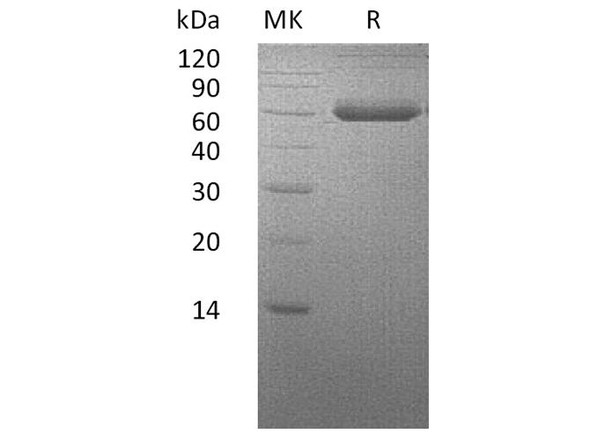
> 95 % as determined by SDS-PAGE
Mol Mass:
42 kDa
AP Mol Mass:
60 kDa
Formulation:
Lyophilized from sterile PBS, pH 7.4
Shipping:
This product is provided as lyophilized powder which is shipped with ice packs.
Stability and Storage:
Lyophilized proteins are stable for up to 12 months when stored at -20 to -80°C. Reconstituted protein solution can be stored at 4-8°C for 2-7 days. Aliquots of reconstituted samples are stable at < -20°C for 3 months.