Cathepsin Z (CTSZ), also known as Cathepsin X or CATX, belongs to the C1 family of lysosomal cysteine proteases. Its gene structure and activity properties show several unique features that distinguish it clearly from other human cysteine proteases. It has a very short pro-region that shows no similarity to those of other cathepsins and a three-residue insertion motif that forms a characteristic ‘mini loop’. Cathepsin Z exhibits mono- and di-peptidase activity at its C-terminus, and in contrast to cathepsin B, it does not act as an endopeptidase. It is restricted to the cells of theimmune system, predominantly monocytes, macrophages and dendritic cells. Cathepsin Z is widely expressed in human tissues, suggesting that this enzyme could be involved in the normal intracellular protein degradation taking place in all cell types. It is capable to cleave regulatory motifs at C-terminus affecting the function of targeted molecules. Cathepsin X may regulate also the maturation of dendritic cells, a process, which is crucial in the initiation of adaptive immunity. Furthermore, higher levels of Cathepsin Z are also found in tumour and immune cells of prostate and gastric carcinomas and inmacrophages of gastric mucosa, especially after infection by Helicobacter pylori. Cathepsin Z is also ubiquitously distributed in cancer cell lines and in primary tumors from different sources, suggesting that this enzyme may participate in tumor progression.
Product Name:
Mouse Cathepsin Z Recombinant Protein (RPES3827)
Product Code:
RPES3827
Size:
10µg
Species:
Mouse
Expressed Host:
HEK293 Cells
Synonyms:
AI787083,AU019819,CTSX,D2Wsu143e
Accession:
NP_071720.1
Sequence:
Met 1-Val 306
Fusion tag:
C-His
Activity:
Measured by its ability to cleave the fluorogenic peptide substrate, Mca-RPPGFSAFK(Dnp)-OH (R&D Systems, Catalog # ES005). The specific activity is >1,200 pmoles/min/µg.
Endotoxin:
<1.0 EU per µg of the protein as determined by the LAL method.
Protein Construction:
A DNA sequence encoding the mouse CTSZ (NP_071720.1) precursor (Met 1-Val 306) was expressed with a polyhistidine tag at the C-terminus.
Purity:
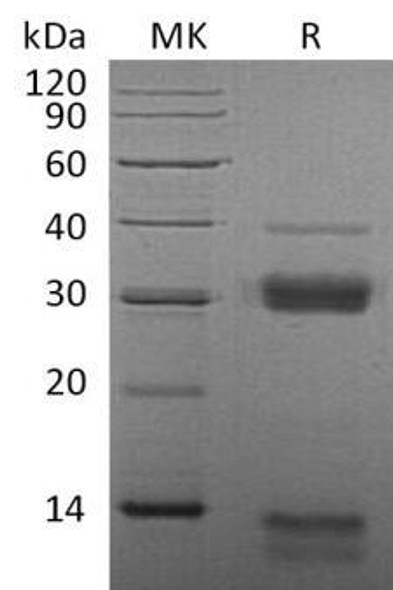
> 95 % as determined by SDS-PAGE
Mol Mass:
33.2 kDa
AP Mol Mass:
38 kDa
Formulation:
Lyophilized from sterile PBS, pH 7.4
Shipping:
This product is provided as lyophilized powder which is shipped with ice packs.
Stability and Storage:
Lyophilized proteins are stable for up to 12 months when stored at -20 to -80°C. Reconstituted protein solution can be stored at 4-8°C for 2-7 days. Aliquots of reconstituted samples are stable at < -20°C for 3 months.