The cluster of differentiation (CD) system is commonly used as cell markers in immunophynotyping. Different kinds of cells in the immune system can be identified through the surface CD molecules which associating with the immune function of the cell. There are more than 320 CD unique clusters and subclusters have been identified. Some of the CD molecules serve as receptors or ligands important to the cell through initiating a signal cascade which then alter the behavior of the cell. Some CD proteins do not take part in cell signal process but have other functions such as cell adhesion. Cluster of differentiation 36 (CD36), also known as FAT, SCARB3, GP88, glycoprotein IV (gpIV) and glycoprotein IIIb (gpIIIb), is a member of the CD system as well as the class B scavenger receptor family of cell surface proteins. CD36 can be found on the surface of many cell types in vertebrate animals and it consists of 472 amino acids and is extensively glycosylated. It is an integral membrane protein primarily serving as receptors for thrombospondin and collagen and by the erythrocytes infected with the human malaria parasite. The role of CD36 as a cell surface receptor has been extended to that of a signal transduction molecule.
Product Name:
Mouse CD36/SCARB3 Recombinant Protein (RPES2732)
Product Code:
RPES2732
Size:
100 µg
Species:
Mouse
Expressed Host:
HEK293 Cells
Synonyms:
FAT,GPIV,Scarb3
Accession:
NP_001153030.1
Sequence:
Gly 30-Lys 439
Fusion tag:
C-His-Fc
Activity:
Measured by its binding ability in a functional ELISA. Immobilized human RSPO1 at 20 µg/ml (100 ?l/well) can bind mouse CD36 Fc chimera with a linear ranger of 6.4-800 ng/ml.
Endotoxin:
<1.0 EU per µg of the protein as determined by the LAL method.
Protein Construction:
A DNA sequence encoding the extracellular domain of mouse CD36 (NP_001153030.1) (Gly 30-Lys 439) was fused with the C-terminal polyhistidine-tagged Fc region of human IgG1 at the C-terminus.
Purity:
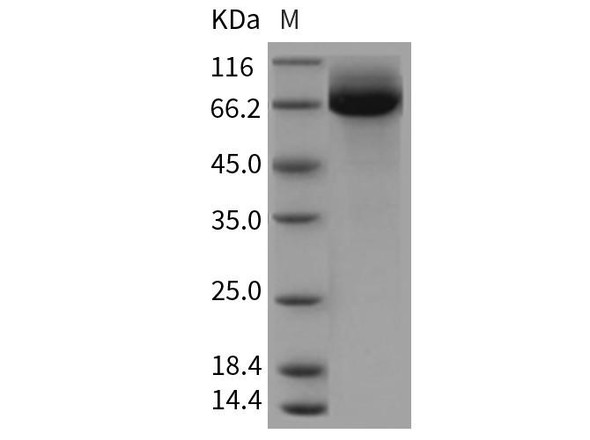
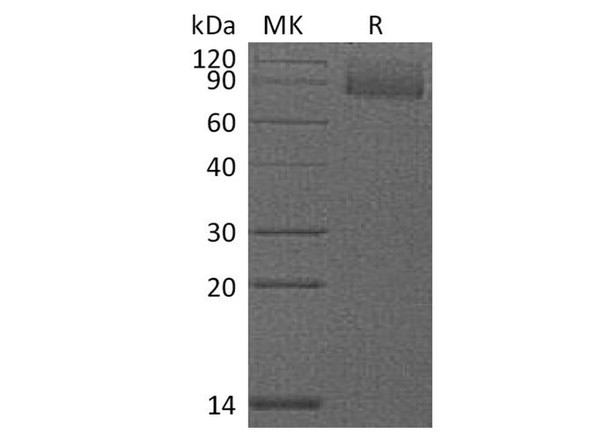
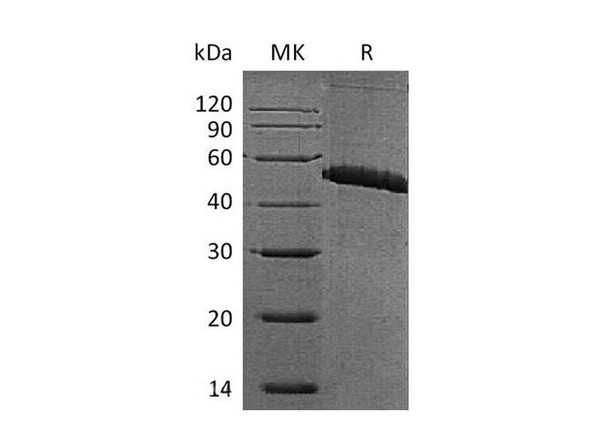
> 88 % as determined by SDS-PAGE
Mol Mass:
74.5 kDa
AP Mol Mass:
110-120 kDa
Formulation:
Lyophilized from sterile PBS, pH 7.4
Shipping:
This product is provided as lyophilized powder which is shipped with ice packs.
Stability and Storage:
Lyophilized proteins are stable for up to 12 months when stored at -20 to -80°C. Reconstituted protein solution can be stored at 4-8°C for 2-7 days. Aliquots of reconstituted samples are stable at < -20°C for 3 months.