High affinity immunoglobulin gamma Fc receptor I, also known as FCGR1 and CD64, is an integral membrane glycoprotein and a member of the immunoglobulin superfamily. CD64 is a high affinity receptor for the Fc region of IgG gamma and functions in both innate and adaptive immune responses. Receptors that recognize the Fc portion of IgG function in the regulation of immune response and are divided into three classes designated CD64, CD32, and CD16. CD64 is structurally composed of a signal peptide that allows its transport to the surface of a cell, three extracellular immunoglobulin domains of the C2-type that it uses to bind antibody, a hydrophobic transmembrane domain, and a short cytoplasmic tail. CD64 is constitutively found on only macrophages and monocytes, but treatment of polymorphonuclear leukocytes with cytokines like IFN? and G-CSF can induce CD64 expression on these cells. The inactivation of the mouse CD64 resulted in a wide range of defects in antibody Fc-dependent functions. Mouse CD64 is an early participant in Fc-dependent cell activation and in the development of immune responses.
Product Name:
Mouse CD64/FCGR1 Recombinant Protein (RPES4941)
Product Code:
RPES4941
Size:
20µg
Species:
Mouse
Expressed Host:
HEK293 Cells
Synonyms:
AI323638,AV092959,CD64,FcgammaRI,IGGHAFC
Accession:
NP_034316.1
Sequence:
Met 1-Pro 297
Fusion tag:
C-His-AVI
Activity:
1. Measured by its ability to bind mouse APCS in a functional ELISA.2. Labeling ratio of biotin to protein: 1.1
Endotoxin:
<1.0 EU per µg of the protein as determined by the LAL method.
Protein Construction:
A DNA sequence encoding the extracellular domain (Met 1-Pro 297) of mouse FCGR1 (NP_034316.1) was fused with a c-terminal polyhistidine tagged AVI tag at the C-terminus. The expressed protein was biotinylated in vivo by the Biotin-Protein ligase (BirA enzyme) which is co-expressed.
Purity:
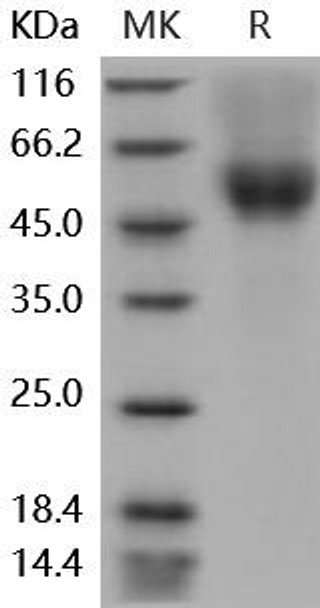
> 90 % as determined by SDS-PAGE
Mol Mass:
34.3 kDa
AP Mol Mass:
50-55 kDa
Formulation:
Lyophilized from sterile PBS, pH 7.4
Shipping:
This product is provided as lyophilized powder which is shipped with ice packs.
Stability and Storage:
Lyophilized proteins are stable for up to 12 months when stored at -20 to -80°C. Reconstituted protein solution can be stored at 4-8°C for 2-7 days. Aliquots of reconstituted samples are stable at < -20°C for 3 months.