Ephrin type-A receptor 6, also known as EphA6 or EHK2, belongs to the ephrin receptor subfamily of the protein-tyrosine kinase family which 16 known receptors (14 found in mammals) are involved: EPHA1, EPHA2, EPHA3, EPHA4, EPHA5, EPHA6, EPHA7, EPHA8, EPHA9, EPHA10, EPHB1, EPHB2, EPHB3, EPHB4, EPHB5, EPHB6. The Eph family of receptor tyrosine kinases (comprising EphA and EphB receptors) has been implicated in synapse formation and the regulation of synaptic function and plasticity6. Eph receptor−mediated signaling, which is triggered by ephrins7, probably modifies the properties of synapses during synaptic activation and remodeling. Ephrin receptors are components of cell signalling pathways involved in animal growth and development, forming the largest sub-family of receptor tyrosine kinases (RTKs). Ligand-mediated activation of Ephs induce various important downstream effects and Eph receptors have been studied for their potential roles in the development of cancer. In the vomeronasal system, Ephrin-A5/EphA6 interactions mediate attraction or adhesion rather than repulsion.
Product Name:
Mouse EphA6/EHK-2 Recombinant Protein (RPES0678)
Product Code:
RPES0678
Size:
100µg
Species:
Mouse
Expressed Host:
HEK293 Cells
Synonyms:
Ehk2,Hek12,m-ehk2
Accession:
NP_031964.2
Sequence:
Met 1-Gln 546
Fusion tag:
C-His
Activity:
Measured by its binding ability in a functional ELISA. Immobilized recombinant mouse EphA6 at 2 µg/ml (100 ?l/well) can bind recombinant human EphrinA3 at a linear range of 0.31-10 ng/ml.
Endotoxin:
<1.0 EU per µg of the protein as determined by the LAL method.
Protein Construction:
A DNA sequence encoding the extracellular domain of mouse EphA6 (NP_031964.2) (Met 1-Gln 546) was expressed, with a C-terminal polyhistidine tag.
Purity:
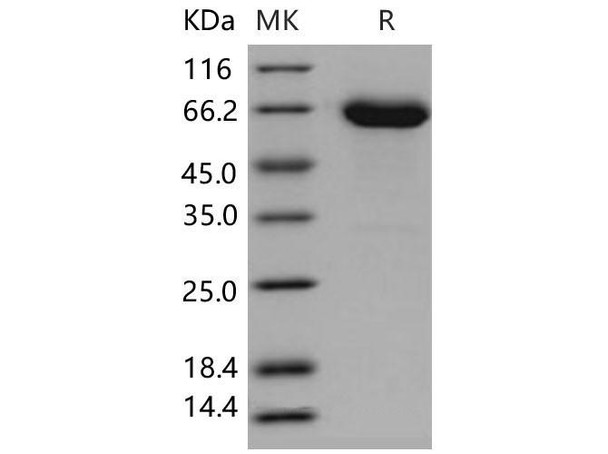
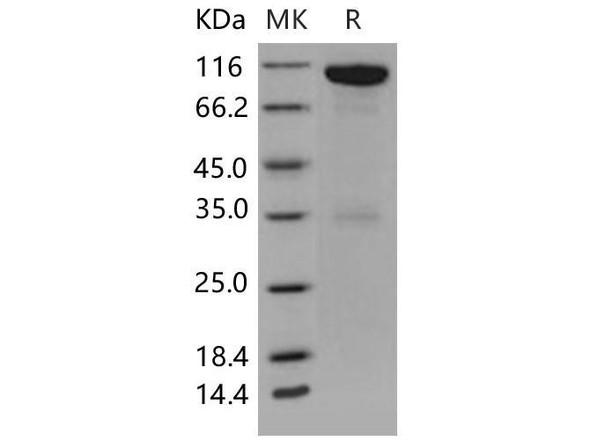
> 97 % as determined by SDS-PAGE
Mol Mass:
59.5 kDa
AP Mol Mass:
65 kDa
Formulation:
Lyophilized from sterile PBS, pH 7.4
Shipping:
This product is provided as lyophilized powder which is shipped with ice packs.
Stability and Storage:
Lyophilized proteins are stable for up to 12 months when stored at -20 to -80°C. Reconstituted protein solution can be stored at 4-8°C for 2-7 days. Aliquots of reconstituted samples are stable at < -20°C for 3 months.