FGFR1, also known as CD331, belongs to the fibroblast growth factor receptor subfamily where amino acid sequence is highly conserved between members and throughout evolution. FGFR family members differ from one another in their ligand affinities and tissue distribution. Fibroblast growth factors (FGFs) (FGF1 - 10 and 16 - 23) are mitogenic signaling molecules that have roles in angiogenesis, wound healing, cell migration, neural outgrowth and embryonic development. FGFs bind heparan sulfate glycosaminoglycans, which facilitates dimerization (activation) of FGF receptors. FGFR1 is a full-length representative protein consists of an extracellular region, composed of three immunoglobulin-like domains, a single hydrophobic membrane-spanning segment and a cytoplasmic tyrosine kinase domain. The extracellular portion of FGFR1 interacts with fibroblast growth factors, setting in motion a cascade of downstream signals, ultimately influencing mitogenesis and differentiation. This particular family member binds both acidic and basic fibroblast growth factors and is involved in limb induction. CD331 can be detected in astrocytoma, neuroblastoma and adrenal cortex cell lines. Some isoforms are detected in foreskin fibroblast cell lines, however isoform 17, isoform 18 and isoform 19 are not detected in these cells. Defects in FGFR1 are a cause of Pfeiffer syndrome ?idiopathic hypogonadotropic hypogonadism? Kallmann syndrome type 2, osteoglophonic dysplasia and trigonocephaly non-syndromic.Immune Checkpoint Immunotherapy Cancer Immunotherapy Targeted Therapy
Measured by its ability to inhibit mouse FGF acidic (aFGF/FGF1) dependent proliferation of Balb/C 3T3 mouse fibroblasts. The ED50 for this effect is typically 6-25 ng/mL in the presence of 0.5 ng/mL of mouse FGF acidic (aFGF/FGF1).
Endotoxin:
<1.0 EU per µg of the protein as determined by the LAL method.
Protein Construction:
A DNA sequence encoding the extracellular domain (Met 1-Glu 376) of mouse FGFR1 isoform 1 (P16092-1) was as fused with the Fc region of human IgG1 at the C-terminus.
Purity:
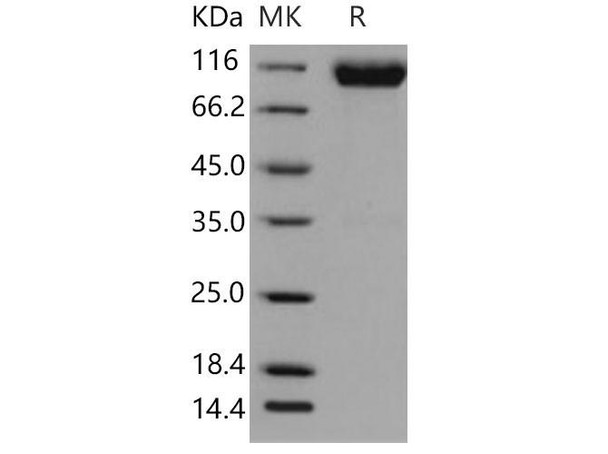
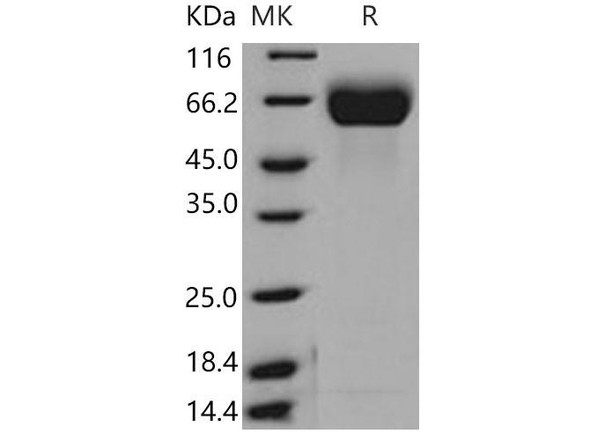
> 97 % as determined by SDS-PAGE
Mol Mass:
66.5 kDa
AP Mol Mass:
100-110 kDa
Formulation:
Lyophilized from sterile PBS, pH 7.4
Shipping:
This product is provided as lyophilized powder which is shipped with ice packs.
Stability and Storage:
Lyophilized proteins are stable for up to 12 months when stored at -20 to -80°C. Reconstituted protein solution can be stored at 4-8°C for 2-7 days. Aliquots of reconstituted samples are stable at < -20°C for 3 months.