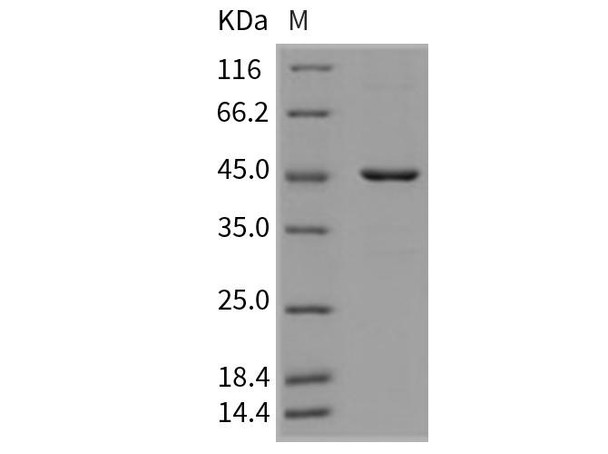
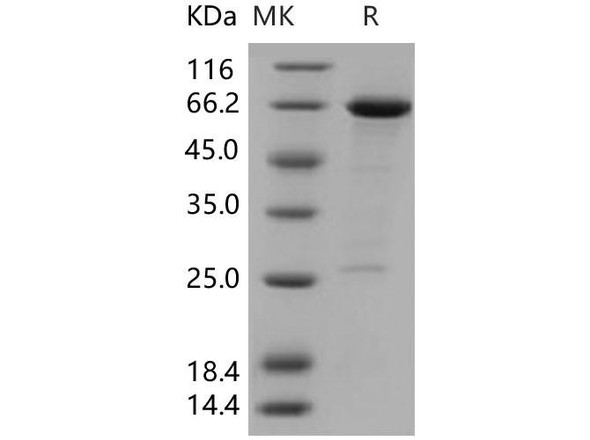
Histone deacetylase 8, also known as HDAC8 and HDACL1, is a nucleus and cytoplasm protein which belongs to the histone deacetylase family and HD type 1 subfamily. Histone deacetylases (HDACs) are a growing family of enzymes implicated in transcriptional regulation by affecting the acetylation state of core histones in the nucleus of cells. HDAC8 / HDACL1 is weakly expressed in most tissues. It expressed at higher level in heart, brain, kidney and pancreas and also in liver, lung, placenta, prostate and kidney. HDAC8 / HDACL1 is responsible for the deacetylation of lysine residues on the N-terminal part of the core histones ( H2A, H2B, H3 and H4 ). Histone deacetylation gives a tag for epigenetic repression and plays an important role in transcriptional regulation, cell cycle progression and developmental events. Histone deacetylases act via the formation of large multiprotein complexes. HDAC8 / HDACL1 may play a role in smooth muscle cell contractility. HDAC8 / HDACL1 may be a potential drug target for neuroblastoma differentiation therapy using selective inhibitors, avoiding unspecific side effects.
Product Name:
Mouse HDAC8/HDACL1 Recombinant Protein (RPES3279)
Product Code:
RPES3279
Size:
100 µg
Species:
Mouse
Expressed Host:
Baculovirus-Insect Cells
Synonyms:
2610007D20Rik
Accession:
Q8VH37-1
Sequence:
Met 1-Val 377
Fusion tag:
C-His
Endotoxin:
<1.0 EU per µg of the protein as determined by the LAL method.
Protein Construction:
A DNA sequence encoding the mouse HDAC8 isoform 1 (Q8VH37-1) (Met 1-Val 377) was expressed?with a C-terminal polyhistidine tag.
This product is provided as lyophilized powder which is shipped with ice packs.
Stability and Storage:
Lyophilized proteins are stable for up to 12 months when stored at -20 to -80°C. Reconstituted protein solution can be stored at 4-8°C for 2-7 days. Aliquots of reconstituted samples are stable at < -20°C for 3 months.