Glycoprotein 130 (also known as gp130, IL6ST, IL6-beta or CD130) is a transmembrane protein which is the founding member of the class of all cytokine receptors. CD130/gp130 is a signal transducer shared by many cytokines, including interleukin 6 (IL6), ciliary neurotrophic factor (CNTF), leukemia inhibitory factor (LIF), and Oncostatin M (OSM). CD130/gp130 functions as a part of the cytokine receptor complex. The activation of this protein is dependent upon the binding of cytokines to their receptors. CD130/gp130 plays a critical role in regulating myocyte apoptosis. Alternatively spliced transcript variants encoding distinct isoforms have been described. A related pseudogene has been identified on chromosome 17. The receptor systems for IL6, LIF, OSM, CNTF, IL11, CTF1 and BSF3 can utilize gp130 for initiating signal transmission. CD130/gp130 binds to IL6/IL6R (alpha chain) complex, resulting in the formation of high-affinity IL6 binding sites, and transduces the signal. CD130/gp130 may have a role in embryonic development. The type I OSM receptor is capable of transducing OSM-specific signaling events.
1. Measured by its ability to bind mouse IL11Ra in a functional ELISA.2. Measured by its ability to inhibit the IL6 R? enhancement of IL6 activity on M1 mouse myeloid leukemia cells (Saito, T. et al. 1991, J. Immunol. 147:168.). The ED50 for this effect is typically 0.6-3 µg/mL in the presence of 10 ng/mL recombinant human IL6 sR and 20 ng/mL recombinant human IL6.
Endotoxin:
<1.0 EU per µg of the protein as determined by the LAL method.
Protein Construction:
A DNA sequence encoding the mouse gp130 (NP_034690.3) extracellular domain (Met 1-Glu 617) was fused with a polyhistidine tag at the C-terminus.
Purity:
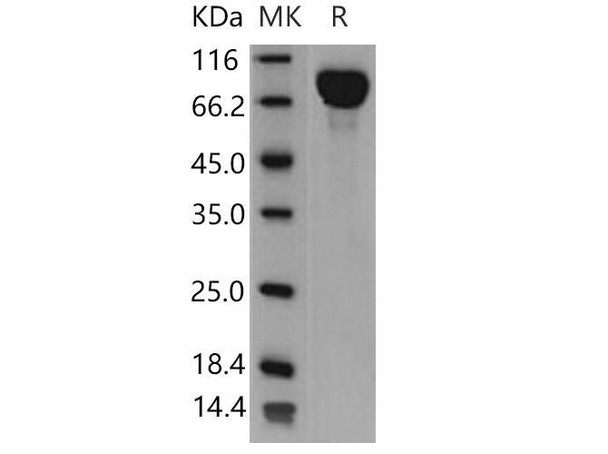
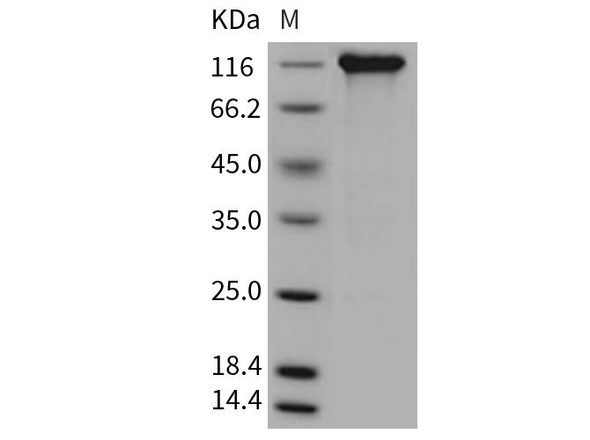
> 97 % as determined by SDS-PAGE
Mol Mass:
68 kDa
AP Mol Mass:
80-90 kDa
Formulation:
Lyophilized from sterile PBS, pH 7.4
Shipping:
This product is provided as lyophilized powder which is shipped with ice packs.
Stability and Storage:
Lyophilized proteins are stable for up to 12 months when stored at -20 to -80°C. Reconstituted protein solution can be stored at 4-8°C for 2-7 days. Aliquots of reconstituted samples are stable at < -20°C for 3 months.