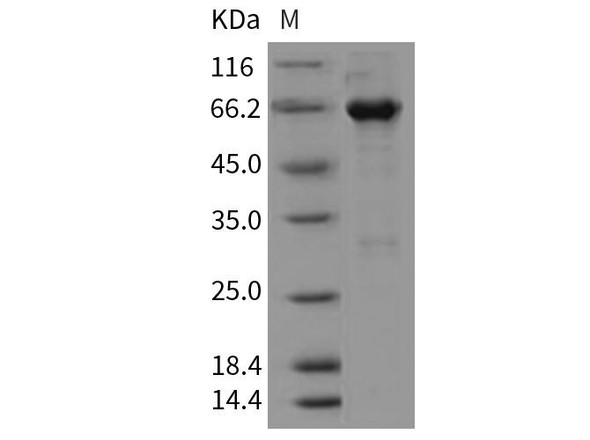
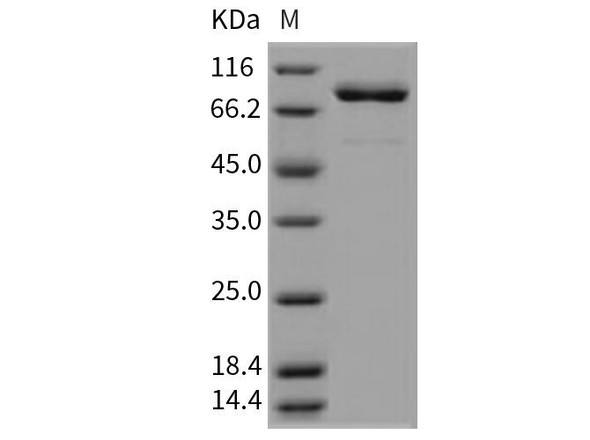
IL-2-inducible T cell kinase is a member of the protein kinase superfamily, Tyr protein kinase family and TEC subfamily. It contains 1 Btk-type zinc finger, 1 PH domain, 1 protein kinase domain, 1 SH2 domain and 1 SH3 domain. As an intracellular kinase which expressed in T-cells, IL-2-inducible T cell kinase contains both SH2 and SH3 domains which are often found in intracellular kinases. It is hought to play a role in T-cell proliferation and differentiation. It regulates the development, function and differentiation of conventional T-cells and nonconventional NKT-cells. IL-2-inducible T cell kinase also plays an essential role in regulation of the adaptive immune response. efects in IL-2-inducible T cell kinase are the cause of lymphoproliferative syndrome EBV-associated autosomal type 1 (LPSA1). LPSA1 is a rare immunodeficiency characterized by extreme susceptibility to infection with Epstein-Barr virus (EBV). Inadequate immune response to EBV can have a fatal outcome. Clinical features include splenomegaly, lymphadenopathy, anemia, thrombocytopenia, pancytopenia, recurrent infections. There is an increased risk for lymphoma.
Product Name:
Mouse ITK Kinase Recombinant Protein (RPES2661)
Product Code:
RPES2661
Size:
50 µg
Species:
Mouse
Expressed Host:
Baculovirus-Insect Cells
Synonyms:
Emt,Tcsk,Tsk
Accession:
Q03526
Sequence:
Arg 351-Leu 619
Fusion tag:
N-His-GST
Endotoxin:
<1.0 EU per µg of the protein as determined by the LAL method.
Protein Construction:
A DNA sequence encoding the mouse ITK / EMT (Q03526) protein kinase domain (Arg 351-Leu 619) was fused with the N-terminal polyhistidine-tagged GST tag at the N-terminus.
This product is provided as lyophilized powder which is shipped with ice packs.
Stability and Storage:
Lyophilized proteins are stable for up to 12 months when stored at -20 to -80°C. Reconstituted protein solution can be stored at 4-8°C for 2-7 days. Aliquots of reconstituted samples are stable at < -20°C for 3 months.