Prostasin (Prss8), also known as channel activating protease 1 (CAP1), is a trypsinlike serine peptidase, and plays important roles in epithelial physiology. It is originally purified as an active, soluble enzyme from human seminal fluid and is highly expressed in prostate, lung, kidney, salivary gland and pancreas. Prostasin is expressed as a glycosyl-phosphatidylinositol (GPI)-anchored membrane protein in prostate epithelial cells, and also exists as a secreted proteolytic enzyme possibly via tryptic cleavage of its COOH-terminal hydrophobic domain. Prostasin is found to activate the epithelial sodium channel (ENaC) which is tightly regulated and is critical for maintaining salt and fluid balance in the lung and kidney in both normal and pathological conditions. Accordingly, prostasin has been proposed as a target for therapeutic inhibition in cystic fibrosis. In addition, prostasin inhibits prostate and breast cancer cell invasion in vitro, suggesting a functional role as a suppressor of tumor invasion, as well as a regulator of gene expression during inflammation.
Product Name:
Mouse Prostasin/PRSS8 Recombinant Protein (RPES4609)
Product Code:
RPES4609
Size:
10µg
Species:
Mouse
Expressed Host:
Baculovirus-Insect Cells
Synonyms:
2410039E18Rik,AI313909,C79772,CAP1,fr,mCAP1
Accession:
EDL17608.1
Sequence:
Ala 30-Gln 289
Fusion tag:
C-His
Endotoxin:
<1.0 EU per µg of the protein as determined by the LAL method.
Protein Construction:
A DNA sequence encoding the mouse PRSS8 (EDL17608.1 ) (Ala 30-Gln 289) was expressed?fused with a polyhistidine tag at the C-terminus and a signal peptide at the N-terminus.
Purity:
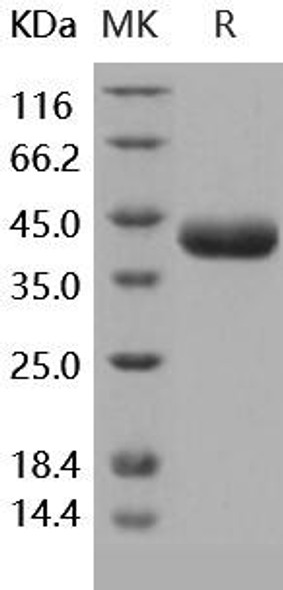
> 97 % as determined by SDS-PAGE
Mol Mass:
29.3 kDa
AP Mol Mass:
35 kDa
Formulation:
Lyophilized from sterile 20mM Tris, 500mM NaCl, pH 7.4
Shipping:
This product is provided as lyophilized powder which is shipped with ice packs.
Stability and Storage:
Lyophilized proteins are stable for up to 12 months when stored at -20 to -80°C. Reconstituted protein solution can be stored at 4-8°C for 2-7 days. Aliquots of reconstituted samples are stable at < -20°C for 3 months.