SIRPB1A (Signal-regulatory protein beta 1A), also known as SIRP beta 1, belongs to signal-regulatory-protein (SIRP) family, and immunoglobulin superfamily. Signal-regulatory proteins (SIRPs) are cell-surface glycoproteins expressed on myeloid and neural cells that have been shown to recruit SH2 domain-containing protein phosphatase 1 (SHP-1) and SHP-2 and to regulate receptor tyrosine kinase-coupled signaling. SIRP are classified as SIRP alpha molecules, containing a 110- to 113-amino acid long, or SIRP beta molecules, with a 5-amino acid long intracytoplasmic domain. SIRP beta 1 is a new DAP12-associated receptor involved in the activation of myeloid cells, which contains a short cytoplasmic domain that lacks sequence motifs capable of recruiting SHP-1 and SHP-2. SIRP beta 1. SIRP beta 1 acts as an activating isoform of SIRP alpha molecules, confirming the co-existence of inhibitory ITIM-bearing molecules, recruiting SHP-1 and SHP-2 protein tyrosine phosphatases, and activating counterparts, whose engagement couples to protein tyrosine kinases via ITAM-bearing molecules.
Product Name:
Mouse SIRPB1A/SIRP beta 1 Recombinant Protein (RPES1605)
Product Code:
RPES1605
Size:
50 µg
Species:
Mouse
Expressed Host:
HEK293 Cells
Synonyms:
9930027N05Rik,SIRP-beta,Sirpb,Sirpb1,Sirpb1a
Accession:
BAD26610.1
Sequence:
Met 1-Lys 363
Fusion tag:
C-His
Endotoxin:
<1.0 EU per µg of the protein as determined by the LAL method.
Protein Construction:
A DNA sequence encoding the mouse SIRPB1A (BAD26610.1) (Met 1-Lys 363) was expressed, with a C-terminal polyhistidine tag.
Purity:
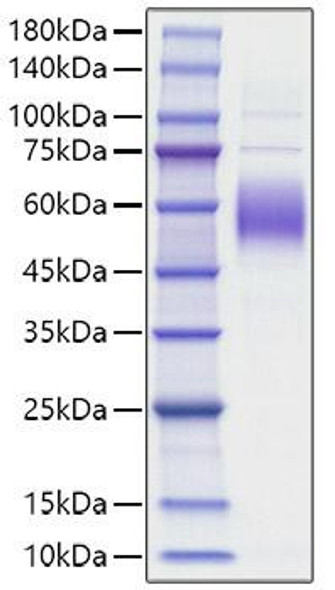
> 98 % as determined by SDS-PAGE
Mol Mass:
39.1 kDa
AP Mol Mass:
55-60 kDa
Formulation:
Lyophilized from sterile PBS, pH 7.4
Shipping:
This product is provided as lyophilized powder which is shipped with ice packs.
Stability and Storage:
Lyophilized proteins are stable for up to 12 months when stored at -20 to -80°C. Reconstituted protein solution can be stored at 4-8°C for 2-7 days. Aliquots of reconstituted samples are stable at < -20°C for 3 months.