FCAR, also called Fc?RI or CD89, is a type I transmembrane receptor for Fc region of IgA which is the most abundant immunoglobulin in mucosal areas but is only the second most common antibody isotype in serum. This receptor is present on the surface of myeloid lineage cells such as neutrophils, monocytes, macrophages, and eosinophils, especially phagocytes located in mucosal areas. Upon ligand IgA binding, Fc?RI associates with the FcR ? signaling molecule bearing the immunoreceptor tyrosine-based activation motif (ITAM) through a unique charge-based mechanism and triggers multiple cell-mediated immune responses. It has been reported that Fc RI is a dual-function receptor that can mediate both inflammatory and anti-inflammatory responses depending on the type of interaction with its ligand. Sustained aggregation of FCAR results in activation of target-cell functions such as antigen presentation and cytokine release. In contrast, Monomeric targeting with serum IgA or with a variety of anti-Fc?RI Fab fragments triggers an inhibitory response and additionally induces apoptosis. Fc?RI thus play an fundamental role in preventing tumor development and growth, as well as in controlling inflammation.
Product Name:
Rat CD89/FCAR Recombinant Protein (RPES0261)
Product Code:
RPES0261
Size:
100 µg
Species:
Rat
Expressed Host:
HEK293 Cells
Synonyms:
CD89
Accession:
NP_973721.1
Sequence:
Met 1-Asn 228
Fusion tag:
C-His
Endotoxin:
<1.0 EU per µg of the protein as determined by the LAL method
Protein Construction:
A DNA sequence encoding the rat FCAR (NP_973721.1) extracellular domain (Met 1-Asn 228) was expressed, fused with a polyhistidine tag at the C-terminus.
Purity:
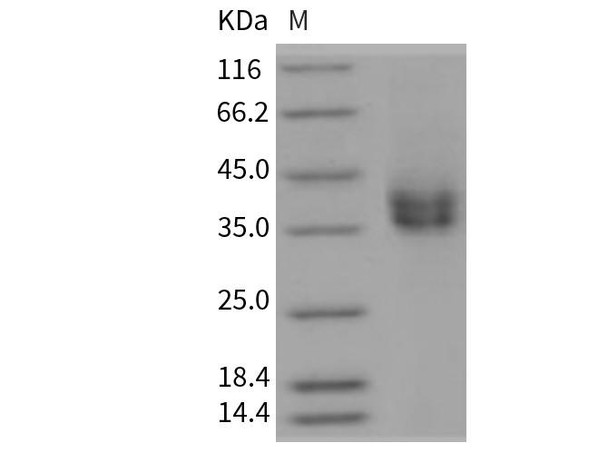
> 95 % as determined by SDS-PAGE
Mol Mass:
24.8 kDa
AP Mol Mass:
35-40 kDa
Formulation:
Lyophilized from sterile PBS, pH 7.4
Shipping:
This product is provided as lyophilized powder which is shipped with ice packs.
Stability and Storage:
Lyophilized proteins are stable for up to 12 months when stored at -20 to -80°C. Reconstituted protein solution can be stored at 4-8°C for 2-7 days. Aliquots of reconstituted samples are stable at < -20°C for 3 months.