Discoidin domain receptor family, member 1 (DDR1), also known as or CD167a (cluster of differentiation 167a), and Mammary carcinoma kinase 10 (MCK10), belongs to a subfamily of tyrosine kinase receptors with an extracellular domain homologous to Dictyostellium discoideum protein discoidin 1. Receptor tyrosine kinases play a key role in the communication of cells with their microenvironment. These kinases are involved in the regulation of cell growth, differentiation and metabolism. Expression of DDR1/MCK10/CD167 is restricted to epithelial cells, particularly in the kidney, lung, gastrointestinal tract, and brain. In addition, it has been shown to be significantly overexpressed in several human tumors. DDR1/MCK10/CD167 plays an important role in regulating attachment to collagen, chemotaxis, proliferation, and MMP production in smooth muscle cells. DDR1 functions in a feedforward loop to increase p53 levels and at least some of its effectors. Inhibition of DDR1 function resulted in strikingly increased apoptosis of wild-type p53-containing cells in response to genotoxic stress through a caspase-dependent pathway.
Product Name:
Rat DDR1 Kinase/CD167 Recombinant Protein (RPES4185)
Product Code:
RPES4185
Size:
100 µg
Species:
Rat
Expressed Host:
HEK293 Cells
Synonyms:
DDR1,MCK10
Accession:
Q6MG19
Sequence:
Met1-Thr413
Fusion tag:
C-His
Endotoxin:
<1.0 EU per µg of the protein as determined by the LAL method
Protein Construction:
A DNA sequence encoding the rat DDR1 (Q6MG19) (Met1-Thr413) was expressed with a polyhistidine tag at the C-terminus.
Purity:
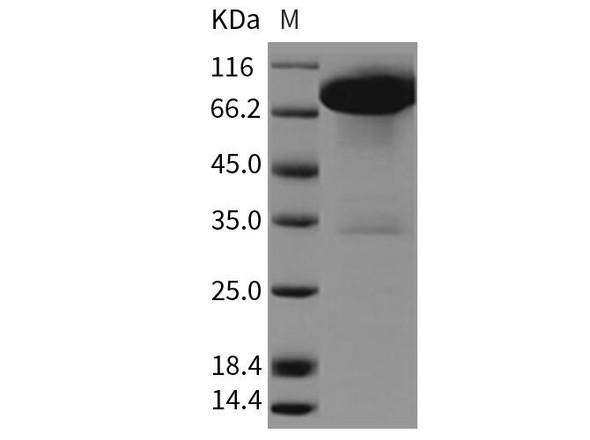
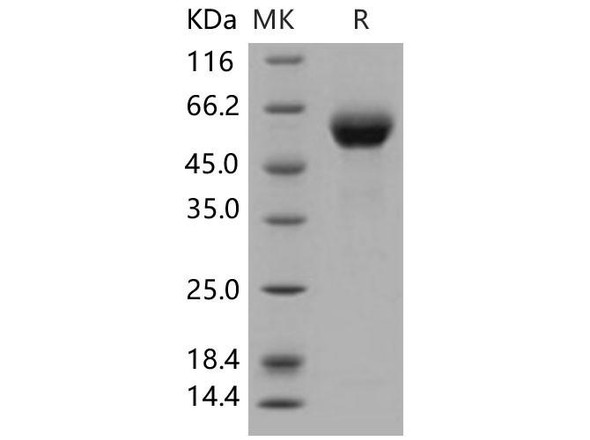
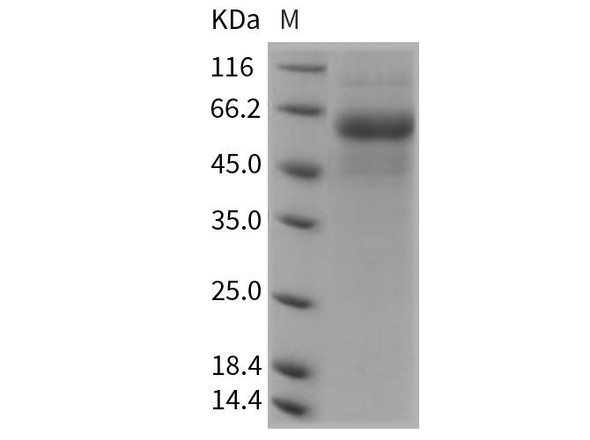
> 95 % as determined by SDS-PAGE
Mol Mass:
45.3 kDa
AP Mol Mass:
52 kDa
Formulation:
Lyophilized from sterile PBS, pH 7.4
Shipping:
This product is provided as lyophilized powder which is shipped with ice packs.
Stability and Storage:
Lyophilized proteins are stable for up to 12 months when stored at -20 to -80°C. Reconstituted protein solution can be stored at 4-8°C for 2-7 days. Aliquots of reconstituted samples are stable at < -20°C for 3 months.