Alanine aminotransferase (ALT), also known as glutamate pyruvate transaminase (GPT), is a pyridoxal enzyme which belongs to the class-I pyridoxal-phosphate-dependent aminotransferase family, Alanine aminotransferase subfamily. Gpt / Gpt1 / ALT catalyses the reversible interconversion of L-alanine and 2-oxoglutalate to pyruvate and L-glutamate, and plays a key role in the intermediary metabolism of glucose and amino acids. Gpt / Gpt1 / ALT is expressed in Liver, kidney, heart, and skeletal muscles and it expresses at moderate levels in the adipose tissue. As a key enzyme for gluconeogenesis, Gpt is a widely-used serum marker for liver injury. Two ALT isoenzymes have been identified, ALT1 and ALT2 (GPT1 and GPT2), which are encoded by separate genes and share significant sequence homology, but differ in their expression patterns. GPT1/GPT is widely distributed and mainly expressed in intestine, liver, fat tissues, colon, muscle, and heart, in the order of high to low expression level. Serum activity levels of this enzyme are routinely used as a biomarker of liver injury caused by drug toxicity, infection, alcohol, and steatosis.
Product Name:
Rat GPT1/GPT Recombinant Protein (RPES0281)
Product Code:
RPES0281
Size:
10µg
Species:
Rat
Expressed Host:
Baculovirus-Insect Cells
Synonyms:
Gpt1,Gpt,ALT1
Accession:
NP_112301.1
Sequence:
Met 1-Ser 496
Fusion tag:
C-His
Endotoxin:
<1.0 EU per µg of the protein as determined by the LAL method
Protein Construction:
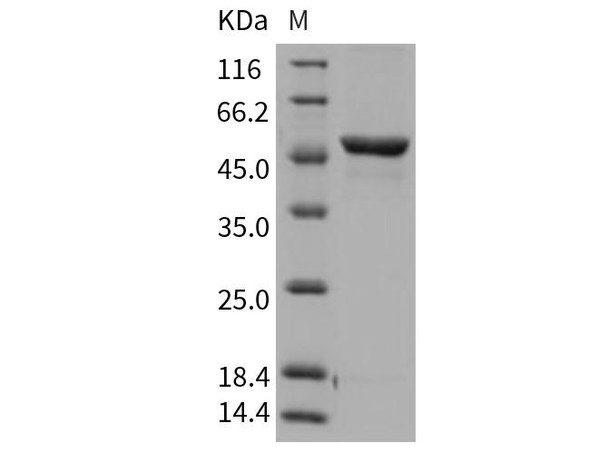
A DNA sequence encoding the rat Gpt1 (NP_112301.1) (Met 1-Ser 496) with a C-terminal polyhistidine tag was expressed.
This product is provided as lyophilized powder which is shipped with ice packs.
Stability and Storage:
Lyophilized proteins are stable for up to 12 months when stored at -20 to -80°C. Reconstituted protein solution can be stored at 4-8°C for 2-7 days. Aliquots of reconstituted samples are stable at < -20°C for 3 months.