Prolactin receptor (PRLR) is a single-pass transmembrane receptor belonging to the type â… cytokine receptor superfamily, and contains two fibronectin type-â…¢ domains. All class 1 ligands activate their respective receptors by clustering mechanisms. Ligand binding results in the transmembrane PRLR dimerization, followed by phosphorylation and activation of the molecules invloved in the signaling pathways, such as Jak-STAT, Ras/Raf/MAPK. The PRLR contains no intrinsic tyrosine kinase cytoplasmic domain but associates with a cytoplasmic tyrosine kinase, JAK2. PRLR mainly serves as the receptor for the pituitary hormone prolactin (PRL), a secreted hormone that affects reproduction and homeostasis in vertebrates. PRLR can be regulated by an interplay of two different mechanisms, PRL or ovarian steroid hormones independently or in combination in a tissue-specific manner. The role of the hormone prolactin (PRL) in the pathogenesis of breast cancer is mediated by its cognate receptor (PRLR). Ubiquitin-dependent degradation of the PRLR that negatively regulates PRL signaling is triggered by PRL-mediated phosphorylation of PRLR on Ser349 followed by the recruitment of the beta-transducin repeats-containing protein (beta-TrCP) ubiquitin-protein isopeptide ligase. which altered PRLR stability may directly influence the pathogenesis of breast cancer.
Product Name:
Rat PRLR/Prolactin Receptor Recombinant Protein (RPES0163)
Product Code:
RPES0163
Size:
100 µg
Species:
Rat
Expressed Host:
HEK293 Cells
Synonyms:
MGC105486,RATPRLR
Accession:
P05710-1
Sequence:
Met 1-Asp 229
Fusion tag:
C-His
Endotoxin:
<1.0 EU per µg of the protein as determined by the LAL method
Protein Construction:
A DNA sequence encoding the rat PRLR (P05710-1) extracellular domain (Met 1-Asp 229) was expressed, fused with a polyhistidine tag at the C-terminus.
Purity:
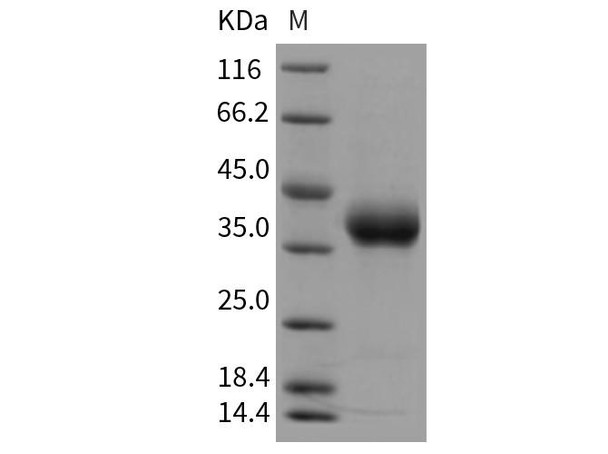
> 97 % as determined by SDS-PAGE
Mol Mass:
26 kDa
AP Mol Mass:
38 kDa
Formulation:
Lyophilized from sterile PBS, pH 7.4
Shipping:
This product is provided as lyophilized powder which is shipped with ice packs.
Stability and Storage:
Lyophilized proteins are stable for up to 12 months when stored at -20 to -80°C. Reconstituted protein solution can be stored at 4-8°C for 2-7 days. Aliquots of reconstituted samples are stable at < -20°C for 3 months.