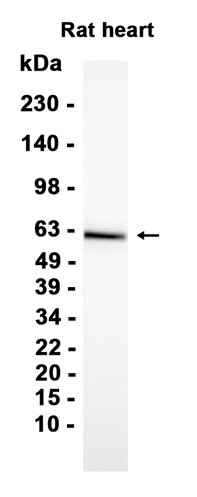
The Recombinant Smad3 Monoclonal Antibody is a recombinant rabbit monoclonal antibody (clone C723223) against Smad3. The protein encoded by this gene belongs to the SMAD, a family of proteins similar to the gene products of the Drosophila gene 'mothers against decapentaplegic' (Mad) and the C. elegans gene Sma. SMAD proteins are signal transducers and transcriptional modulators that mediate multiple signaling pathways. This protein functions as a transcriptional modulator activated by transforming growth factor-beta and is thought to play a role in the regulation of carcinogenesis. Produced by recombinant technology in Rabbit hosts and purified by affinity chromatography, this Rabbit IgG antibody is reactive against Human and Rat samples.
This antibody is suitable for WB and IHC-P applications. It has been validated by WB analysis of Jurkat, C6, Hela and IHC analysis of Human breast cancer. The target is localized to the Cytoplasm. Nucleus. Cytoplasmic and nuclear in the absence of TGF-beta. On TGF-beta stimulation, migrates to the nucleus when complexed with SMAD4 (PubMed:15799969). Through the action of the phosphatase PPM1A, released from the SMAD2/SMAD4 complex, and exported out of the nucleus by interaction with RANBP1 (PubMed:16751101, PubMed:19289081). Co-localizes with LEMD3 at the nucleus inner membrane (PubMed:15601644). MAPK-mediated phosphorylation appears to have no effect on nuclear import (PubMed:19218245). PDPK1 prevents its nuclear translocation in response to TGF-beta (PubMed:17327236).
Product Name:
Recombinant Smad3 Monoclonal Antibody
SKU:
AGEL8528
Size:
50 µL, 100 µL
Antibody Type:
Recombinant Monoclonal Antibody
Synonyms:
DKFZP586N0721, DKFZp686J10186, hMAD 3, hMAD-3, hSMAD3, HSPC193, HST17436, JV15 2, JV15-2, JV152, LDS1C, LDS3, MAD, MAD (mothers against decapentaplegic Drosophila) homolog 3, MAD homolog 3, Mad homolog JV15 2, Mad protein homolog, Mad3, MADH 3, MADH3, MGC60396, mothers against decapentaplegic homolog 3, Mothers against DPP homolog 3, SMA and MAD related protein 3, SMAD, SMAD 3, SMAD family member 3, Smad3