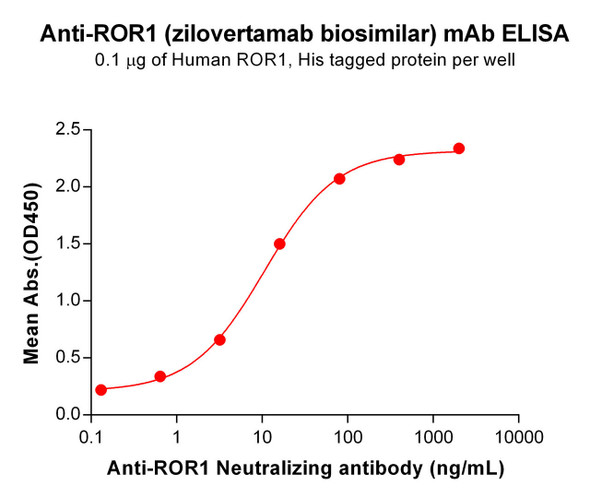
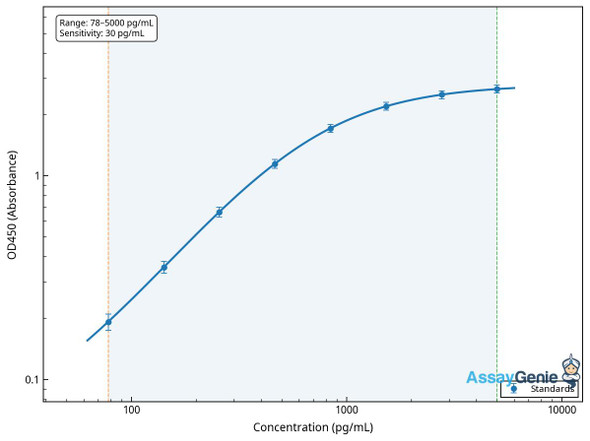
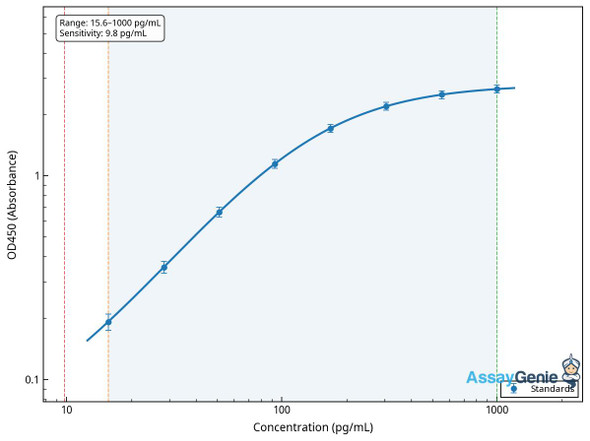
ROR1 Antibody is a rabbit polyclonal antibody directed against ROR1, offered by Assay Genie for research applications. Reported applications include WB and IHC. Reported reactivity: Human, Mouse and Rat. Purified by Peptide Affinity.
Receptor tyrosine kinase-like orphan receptor 1 (ROR1) is a member of the ROR family of transmembrane proteins involved in non-canonical Wnt signaling. While ROR1 is best known for its role in embryonic development and cancer biology, emerging evidence highlights its significance in the nervous system, particularly in the context of neurodegenerative diseases. In the adult brain, ROR1 expression is typically low but becomes upregulated in response to injury or pathological stress. Recent studies have shown that ROR1 can counteract cytoskeletal degradation induced by amyloid-beta (Aβ1–42), a hallmark of Alzheimer’s disease. Overexpression of ROR1 in neuronal models preserves actin filament integrity, promotes neuritogenesis, and mitigates Aβ-induced cytoskeletal instability. ROR1 is also regulated by non-coding RNAs, including miR-146a and NEAT1, which are dysregulated in Alzheimer’s disease. This regulatory axis suggests that ROR1 is part of a broader epigenetic network influencing neuronal structure and resilience. Additionally, ROR1-mediated signaling may support axonal growth, synaptic maintenance, and neuroregeneration through Wnt5a-dependent pathways. Given its role in maintaining cytoskeletal architecture and responding to neurotoxic stress, ROR1 represents a promising therapeutic target for neurodegenerative diseases. Modulating ROR1 expression or activity could offer novel strategies to preserve neuronal integrity and slow disease progression. This antibody is also available conjugated to ATTO 390, ATTO 488, ATTO 594, APC, Biotin, FITC, HRP, PerCP and RPE. Supplied in 100 µg. For research use only; not for diagnostic or therapeutic procedures.
Product Name:
ROR1 Antibody
Product SKU:
STPA00081
Size:
100 µg
Target:
ROR1
Host Species:
Rabbit
Antibody Type:
Polyclonal
Research Areas:
Cell Signaling, Protein Phosphorylation, Tyrosine Kinases, Receptor Tyrosine Kinases, Neuroscience
Buffer:
PBS pH 7.4, 50% glycerol, 0.09% sodium azide
Storage & Shipping:
Store at -20°C. Shipped on Blue Ice or 4°C. Conjugated variants should be stored according to the product label.
Format:
Liquid
Applications:
WB, IHC
Purification:
Peptide Affinity Purified
Concentration:
1 mg/ml
Reactivity:
Human, Mouse, Rat
Recommended Dilution:
WB (1:1000); IHC (1:50); optimal dilutions for assays should be determined by the user.
Specificity:
Detects 43 kDa. 43 kDa is Isoform 3.
Guarantee:
12 months from date of dispatch
Immunogen:
Synthetic peptide from the mid-protein of Human ROR1 (aa. 200-300)
Immunogen Species:
Human
Accession Number:
NP_001077061.1
Gene ID:
4919
Swiss-Prot:
Q01973
Cellular Localization:
Membrane | Single-Pass Type I Membrane Protein
Tissue Specificity:
Expressed strongly in human heart, lung and kidney, but weakly in the CNS. Isoform Short is strongly expressed in fetal and adult CNS and in a variety of human cancers, including those originating from CNS or PNS neuroectoderm.
1. Chanda, K., Jana, N. R., & Mukhopadhyay, D. (2021). Receptor tyrosine kinase ROR1 ameliorates Aβ1–42-induced cytoskeletal instability and is regulated by the miR146a-NEAT1 nexus in Alzheimer’s disease. Scientific Reports, 11, 19254. https://doi.org/10.1038/s41598-021-98882-0 2. Makin, S. (2025, April 16). The future of Alzheimer’s treatment. Nature Outlook: Alzheimer’s Disease. https://www.nature.com/articles/d41586-025-01102-2


![Anti-ROR1 [R06-9A-7] Monoclonal Antibody (AGMB04017)](https://cdn11.bigcommerce.com/s-h68l9z2lnx/images/stencil/590x590/products/275306/677322/anti-ror1-r06-9a-7-monoclonal-antibody-agmb04017__44857.1773032201.jpg?c=2 "Anti-ROR1 [R06-9A-7] Monoclonal Antibody (AGMB04017)")