Description
Total Sulfhydryl Group/Total Thiol (-SH) Colorimetric Assay Kit
The Total Sulfhydryl Group/Total Thiol (-SH) Colorimetric Assay Kit (MAES0167) measures total sulfhydryl (-SH) content in serum, plasma, and animal tissue samples. The assay uses 5,5'-dithiobis(2-nitrobenzoic acid) (DTNB) and is read on a microplate reader at 410-420 nm. Researchers use it to study thiol status in oxidative stress research, where sulfhydryl groups are key REDOX-active residues.
Total sulfhydryl (-SH) content, also listed as T-SH, is the analyte this kit measures. Sulfhydryl compounds are reactive sulfur-containing groups, and the kit reports their combined amount in a sample rather than the level of one named molecule. The product is assigned to the oxidative stress research area. The kit is designed for research use only, and the source materials describe it as a tool for measuring total -SH content rather than a single biomarker.
Researchers use this kit to quantify total -SH content in biological matrices that are common in oxidative stress studies. The intended use covers serum, plasma, and animal tissue samples, which lets a single protocol be applied across these sample types. The source materials do not name specific disease models or physiological conditions, so the kit should be applied within research workflows only. The manual states explicitly that it is not for clinical diagnosis.
The assay relies on the reaction of sulfhydryl compounds with 5,5'-dithiobis(2-nitrobenzoic acid) under neutral or alkaline conditions. This reaction produces a yellow product with a maximum absorption peak at 412 nm. Standard and sample wells receive a buffer solution followed by a chromogenic agent, while control wells receive absolute ethyl alcohol in place of the chromogenic agent. After mixing and a 10-minute incubation at room temperature, optical density is read at 412 nm on a microplate reader. Total -SH content is then calculated indirectly from a standard curve.
Serum and plasma are assayed directly without extraction. For tissue, a 20 mg sample is washed in cold 0.9% NaCl, homogenized in 180 µL normal saline at 4°C, and centrifuged at 10000×g for 10 minutes to remove insoluble material. The supernatant is kept on ice until testing. Human urine is listed with a dilution factor of 1. The manual notes that high protein concentrations can make the reaction turbid after the chromogenic agent is added, so such samples should be diluted and retested. Reagents are stored at 2-8°C, protected from light, for 12 months.
Analytical sensitivity is 9.91 µmol/L, determined by adding two standard deviations to the mean OD of the zero standard assayed 20 times and converting the result to concentration. The detection range is 9.91 to 1000 µmol/L. Intra-assay CV ranged from 2.3% to 2.8% across three human serum samples assayed in replicates of 20. Inter-assay CV ranged from 2.6% to 3.1% across 17 duplicate runs by three operators. Recovery averaged 104%, with individual concentrations recovering between 101% and 106%.
| Product name: | Total Sulfhydryl Group/Total Thiol (-SH) Colorimetric Assay Kit |
| SKU: | MAES0167 |
| Size: | 96 Assays |
| Synonym: | T-SH |
| Sample type: | Serum, plasma, animal tissue |
| Detection method: | Colorimetric (DTNB) |
| Instrument: | Microplate reader, 410-420 nm |
| Assay time: | 20 min |
| Research area: | Oxidative stress |
| Sensitivity: | 9.91 µmol/L |
| Detection range: | 9.91-1000 µmol/L |
| Intra-assay CV: | 2.5% |
| Inter-assay CV: | 2.9% |
| Recovery rate: | 104% |
| Sample volume per well: | 40 µL |
| Recommended dilution, human serum and plasma: | 4-6-fold |
| Recommended dilution, human urine: | 1 (undiluted) |
| Recommended dilution, rabbit serum: | 3-5-fold |
| Recommended dilution, porcine serum: | 4-6-fold |
| Recommended dilution, 10% rat liver, kidney, or spleen homogenate: | 4-6-fold |
- Colorimetric measurement of total sulfhydryl (-SH) and thiol content
- Detection range 9.91-1000 µmol/L; sensitivity 9.91 µmol/L
- Validated sample types: serum, plasma, and animal tissue homogenates
- Read at 410-420 nm on a standard microplate reader
- Total assay time of 20 min; 96 Assays per kit
Sulfhydryl compounds react with 5,5'-dithiobis(2-nitrobenzoic acid) under neutral or alkaline conditions to produce a yellow product with a maximum absorption peak at 412 nm. The OD value is measured and the total mercapto content is calculated indirectly from the standard curve.
- Oxidative stress research
- Measurement of total thiol (-SH) content in human and animal serum or plasma
- Thiol content profiling in 10% rat liver, kidney, and spleen tissue homogenates
- REDOX-related studies of sulfhydryl-containing proteins and low molecular weight thiols
| Component | Quantity | Storage |
| Reagent 1: Buffer Solution | 20 mL × 1 vial | 2-8°C, 12 months |
| Reagent 2: Chromogenic Agent | 1.3 mL × 1 vial | 2-8°C, 12 months, protect from light |
| Reagent 3: Standard Powder | 2 vials | 2-8°C, 12 months |
| Microplate | 96 wells | No storage requirement |
- Microplate reader capable of 410-420 nm (412 nm reading)
- Micropipettor
- Water bath
- Incubator
- Vortex mixer
- Centrifuge (capable of 10000 × g)
- Homogenizer (for tissue samples)
- Fume hood (kit contains a pungent-odor reagent)
- Double-distilled water
- Absolute ethyl alcohol (self-prepared for control wells)
- Normal saline (0.9% NaCl)
- Phosphate-buffered saline, 0.01 M, pH 7.4 (optional diluent)
Serum/plasma
- Detect serum and plasma samples directly.
- If samples are not detected on the same day, store serum or plasma at -80°C for up to one month.
- Dilute human serum and human plasma 4-6 fold with normal saline (0.9% NaCl) before testing, using the recommended dilution factor for the sample type.
- Dilute rabbit serum 3-5 fold and porcine serum 4-6 fold with normal saline before testing.
- For other sample types, perform a pretest to confirm the dilution factor. The diluent is normal saline (0.9% NaCl) or PBS (0.01 M, pH 7.4).
Tissue
- Harvest the amount of tissue needed for each assay (initial recommendation: 20 mg).
- Wash the tissue in cold normal saline (0.9% NaCl).
- Homogenize 20 mg tissue in 180 µL normal saline (0.9% NaCl) with a dounce homogenizer at 4°C.
- Centrifuge at 10000×g for 10 minutes to remove insoluble material.
- Collect the supernatant and keep it on ice for detection.
- Dilute 10% rat liver, kidney, or spleen tissue homogenate 4-6 fold with normal saline before testing.
Urine
- Use human urine at a dilution factor of 1 (no dilution), per the manual's dilution table.
- For other sample types, perform a pretest to confirm the dilution factor.
Reagent and standard preparation
- Equilibrate reagents to room temperature before use.
- Prepare 5 mmol/L standard solution by diluting one vial of Standard Powder with 10 mL normal saline; mix well. Store at 2-8°C for up to 1 day.
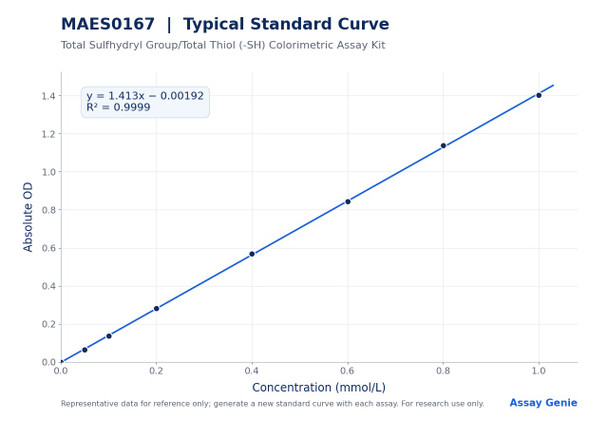
- Prepare a fresh standard curve for each assay: dilute the 5 mmol/L standard with normal saline to 0, 0.05, 0.1, 0.2, 0.4, 0.6, 0.8, and 1.0 mmol/L (standard volumes 0, 10, 20, 40, 80, 120, 160, and 200 µL, with normal saline 1000, 990, 980, 960, 920, 880, 840, and 800 µL, respectively). Discard working standards after use.
Sample preparation
- Serum and plasma: assay directly. If not assayed the same day, store at -80°C for up to 1 month.
- Tissue: wash tissue in cold normal saline (0.9% NaCl). Homogenize 20 mg tissue in 180 µL normal saline at 4°C.
- Centrifuge at 10000 × g for 10 min. Collect the supernatant, clarify it, and keep on ice until assay.
- Dilute samples as needed (see Properties); use normal saline as diluent.
Assay procedure
- Standard wells: add 40 µL of each standard. Sample wells: add 40 µL of sample. Control wells: add 40 µL of sample.
- Add 150 µL Buffer Solution to each well.
- Add 10 µL Chromogenic Agent to standard and sample wells.
- Add 10 µL absolute ethyl alcohol (self-prepared) to control wells.
- Mix thoroughly and incubate for 10 min at room temperature.
- Read OD at 412 nm on a microplate reader.
Calculation
- Average duplicate readings. Subtract the mean OD of the blank (standard 1) from all standard readings to obtain absolute OD values.
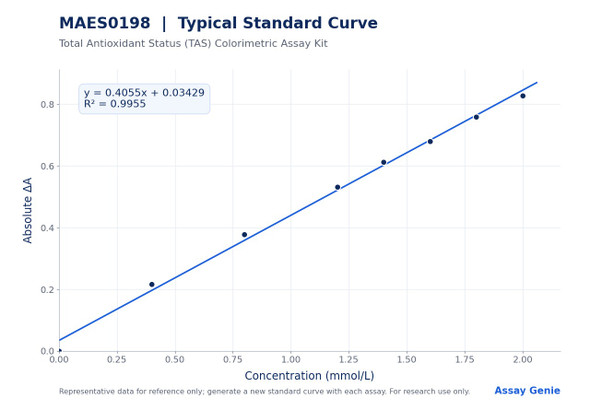
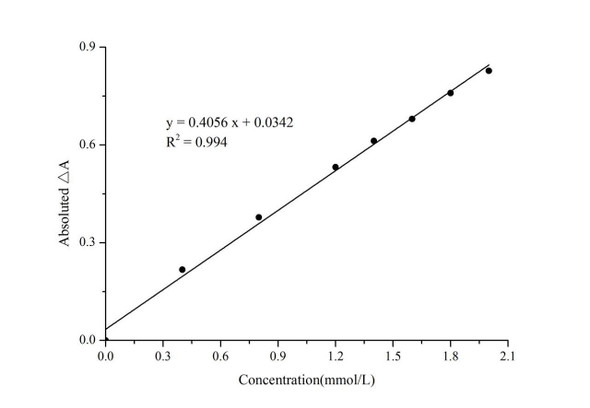
- Plot absolute OD (y) against concentration in mmol/L (x) and fit a linear standard curve (y = ax + b).
- Serum or plasma: Total (-SH) content (µmol/L) = (ΔA412 - b) ÷ a × 1000 × f, where ΔA412 = OD sample - OD control and f is the dilution factor.
- Tissue: Total (-SH) content (µmol/g fresh weight) = (ΔA412 - b) ÷ a ÷ (m ÷ V) × f, where m is sample fresh weight (g) and V is the normal saline volume used in preparation (mL).
Serum/plasma: Total (-SH) content (µmol/L) = (ΔA412 - b) ÷ a × 1000 × f Tissue: Total (-SH) content (µmol/g fresh weight) = (ΔA412 - b) ÷ a ÷ (m ÷ V) × f
- a and b are the slope and intercept of the standard curve y = ax + b, where y is the absolute OD value of each standard (OD of standard minus the mean OD of the blank, Standard ①) and x is standard concentration in mmol/L.
- ΔA412 = OD sample - OD control, both read at 412 nm.
- 1000 converts mmol/L to µmol/L (1 mmol/L = 1000 µmol/L).
- f is the dilution factor of the sample before testing. Multiply the calculated value by f to correct for dilution.
- m is the fresh weight of the tissue sample in grams.
- V is the volume of normal saline used in the tissue preparation step, in mL.
- Serum and plasma results are reported in µmol/L; tissue results are reported in µmol/g fresh weight.
Which sample types can be tested with this kit?
The kit measures total -SH content in serum, plasma, and animal tissue samples. The manual's dilution table also lists human urine (dilution factor 1) and 10% rat liver, kidney, and spleen tissue homogenates. For other sample types, a pretest is recommended to confirm the dilution factor.
How should reagents and samples be stored?
Reagents should be stored at 2-8°C for 12 months, with the chromogenic agent protected from light. Serum and plasma that are not tested on the day of collection can be stored at -80°C for up to one month.
What should I do if my sample is outside the detection range?
The detection range is 9.91 to 1000 µmol/L. If the concentration is not within this range, the manual recommends an extra dilution or concentration of the sample. Samples with high protein concentration should be diluted and retested because they can become turbid after the chromogenic agent is added.
What are the key points for running the assay safely and accurately?
The chromogenic agent has a pungent odor, so the assay should be performed in a fume hood. The supernatant from tissue preparation must be clarified by centrifugation before testing. Wear a lab coat and latex gloves during testing.
What instrument settings should I use?
Use a microplate reader set to 410-420 nm. Read the OD of each well at 412 nm, which is the maximum absorption peak of the yellow product.
How long does the assay take?
The kit has an assay time of 20 minutes. In the protocol, the plate is mixed and incubated for 10 minutes at room temperature before the OD is read at 412 nm.
| Storage: | 2-8°C, protect from light |
| Shelf life: | 12 months |
| Shipping: | Gel pack |
| Standard working solution: | Store at 2-8°C for up to 1 day; prepare fresh for each assay |
| Serum and plasma samples: | Store at -80°C for up to 1 month if not assayed the same day |
Notes
- Research Use Only. Not for clinical diagnosis or other therapeutic use.
- The kit contains a pungent-odor reagent; perform the assay in a fume hood.
- Clarify tissue and sample supernatants by centrifugation before use.
- High protein concentrations can make the reaction turbid after Chromogenic Agent addition; dilute the sample and retest.
- If results fall outside the detection range, dilute or concentrate the sample.
- Prepare fresh standards for each assay and discard working standards after use.
- Do not mix reagents between kits of different lots.
- Centrifuge small volumes of reagent before use to ensure sufficient recovery.
- Run a pre-test for sample types not listed in the protocol to confirm dilution factor.