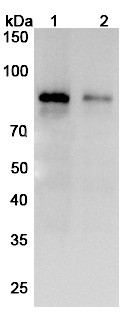
Zampilimab Antibody is a research-grade biosimilar monoclonal antibody targeting Protein-glutamine deamidase TGM2. It is a humanized IgG4-kappa antibody. Reactivity: Human. Supplied as a liquid in 0.01M PBS pH 7.4. Applications: ELISA, flow cytometry, functional assays and in vivo research. Endotoxin: < 10 EU/mg. Purity: >95% purity as determined by SDS-PAGE. For research use only.
Protein-glutamine gamma-glutamyltransferase 2 (TGM2) is a ~77 kDa protein. Calcium-dependent acyltransferase that catalyzes the formation of covalent bonds between peptide-bound glutamine and various primary amines, such as gamma-amino group of peptide-bound lysine, or mono- and polyamines, thereby producing cross-linked or aminated proteins, respectively. Involved in many biological processes, such as bone development, angiogenesis, wound healing, cellular differentiation, chromatin modification and apoptosis. Acts as a protein-glutamine gamma-glutamyltransferase by mediating the cross-linking of proteins, such as ACO2, HSPB6, FN1, HMGB1, RAP1GDS1, SLC25A4/ANT1, SPP1 and WDR54. Under physiological conditions, the protein cross-linking activity is inhibited by GTP; inhibition is relieved by Ca(2+) in response to various stresses. When secreted, catalyzes cross-linking of proteins of the extracellular matrix, such as FN1 and SPP1 resulting in the formation of scaffolds.
Product Name:
Zampilimab Antibody
SKU:
GXBS00446
Size:
100 µg, 1 mg
Antibody Type:
Monoclonal Antibody
Target:
Protein-glutamine deamidase TGM2
Isotype:
IgG4-kappa
Host Species:
Human
Reactivity:
Human
Applications:
ELISA, FCM, Functional assay, Research in vivo
Expression Host:
Mammalian cells
Synonyms:
UCB-7858, UCB7858, 2098280-42-1
Purity:
>95% as determined by SDS-PAGE.
Endotoxin Level:
< 10 EU/mg
Formulation:
0.01M PBS pH 7.4.
State of Matter:
Liquid
Regulatory Status:
For research use only. Not suitable for clinical or therapeutic use.
Product Preparation:
Protein A/G purified from cell culture supernatant.
Storage and Handling:
Store at 2 to 8°C for frequent use. Store at -20 to -80°C for twelve months from the date of receipt.