Description
Adenosine Diphosphate Glucose Prophosphorylase (AGP) Activity Assay Kit
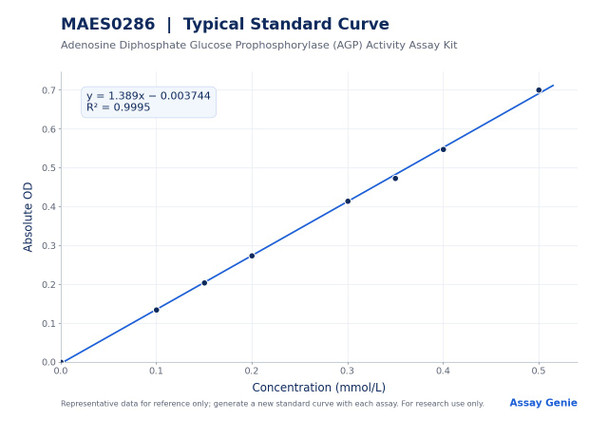
The Adenosine Diphosphate Glucose Prophosphorylase (AGP) Activity Assay Kit (MAES0286) measures AGP enzyme activity in plant tissue samples using a colorimetric readout at 450 nm. The enzyme converts the substrate to an intermediate that forms chromogenic products, and activity is calculated from the absorbance change against a standard curve. The kit is intended for Research Use Only in plant physiology studies.
Adenosine diphosphate glucose pyrophosphorylase (AGP) is the enzyme measured by this kit. It acts on a substrate to produce an intermediate product, which is then converted by enzyme catalysis into chromogenic substances. The assay targets AGP activity in plant tissue samples, and AGP is the analyte of the kit's intended use. Activity is calculated per gram of tissue protein, so enzyme activity is normalized to the protein content of each homogenate.
Researchers measure AGP activity in plant tissues within plant physiology studies, the research area listed for this kit. The intended use is measurement of AGP activity in plant tissue samples, and the listed example sample types include corn, Epipremnum aureum, asparagus, and barley tissue homogenates. The manual's example analysis also includes green radish leaf tissue, which allows several homogenates to be run side by side under one protocol. The kit is for research use only and is not intended for clinical diagnosis.
In the assay, a 96-well microplate is loaded with 20 µL of standard, sample, or control per well. Standard and sample wells receive 140 µL of measuring working solution, which contains buffer, enzymatic reagent, substrate A, and accelerants A and B, while control wells receive 160 µL of control working solution. Chromogenic working solution (substrate B plus chromogenic agent) is added at 40 µL to standard and sample wells, and 20 µL of chromogenic agent is added to control wells. After a 5 s mix on the reader, the plate is incubated at 37 °C for 5 min in shading light and read at 450 nm, the optimum wavelength within the 440-460 nm range.
Tissue is harvested at an initial recommendation of 20 mg per assay and washed in cold PBS (0.01 M, pH 7.4). The tissue is homogenized in 180 µL of normal saline (0.9% NaCl) with a dounce homogenizer at 4 °C. The homogenate is centrifuged at 10000×g for 10 min at 4 °C to remove insoluble material, and the supernatant is kept on ice until detection. The protein concentration of the supernatant is measured separately, because it is required in the calculation.
The analytical sensitivity is 0.5 U/L, determined by adding two standard deviations to the mean OD of the zero standard across 20 replicates. The detection range is 0.5-81.59 U/L. Intra-assay precision ranged from 3.0% to 4.2% CV for three barley tissue samples assayed in replicates of 20. Inter-assay precision ranged from 5.5% to 10.0% CV for samples assayed 20 times in duplicate by three operators. Recovery at three concentrations ranged from 97% to 102%, with an average of 99%.
| Product name: | Adenosine Diphosphate Glucose Prophosphorylase (AGP) Activity Assay Kit |
| SKU: | MAES0286 |
| Synonyms: | AGP |
| Sample type: | Plant tissue |
| Assay type: | Enzyme activity |
| Detection method: | Colorimetric |
| Detection instrument: | Microplate reader (440-460 nm; optimum wavelength 450 nm) |
| Research area: | Plant physiology |
| Detection method: | Colorimetric |
| Wavelength: | 450 nm (microplate reader filter range 440-460 nm) |
| Sensitivity: | 0.5 U/L |
| Detection range: | 0.5-81.59 U/L |
| Intra-assay CV: | 3.0-4.2% |
| Inter-assay CV: | 5.5-10.0% |
| Spike recovery: | 97-102% (average 99%) |
| Sample volume: | 20 µL per well (tissue homogenate supernatant) |
| Reaction time: | 5 min at 37°C |
- Colorimetric detection of AGP activity read at 450 nm on a microplate reader (440-460 nm filter range)
- Detection range 0.5-81.59 U/L with a sensitivity of 0.5 U/L
- Intra-assay CV 3.0-4.2% and inter-assay CV 5.5-10.0%
- Validated for plant tissue homogenates, with a 0.5 mmol/L standard solution for the standard curve
- Activity normalized to protein concentration (U/g prot)
- Stored at -20°C for 12 months
Adenosine diphosphate glucose pyrophosphorylase (AGP) catalyzes the substrate to produce an intermediate product, which produces chromogenic substances after enzyme catalysis. The substance has a maximum absorption peak at around 450 nm, and AGP activity is calculated from the OD value at 450 nm.
- Measuring AGP enzyme activity in plant tissue homogenates in plant physiology studies
- Comparing AGP activity across plant tissue types, such as corn, asparagus, and barley homogenates
- Quantifying AGP activity relative to tissue protein content (U/g prot)
| Component | Storage |
| Buffer Solution | -20°C, 12 months |
| Enzymatic Reagent | -20°C, 12 months |
| Substrate A (Powder) | -20°C, 12 months |
| Substrate B | -20°C, 12 months |
| Accelerant A | -20°C, 12 months |
| Chromogenic Agent | -20°C, 12 months, protect from light |
| Accelerant B | -20°C, 12 months |
| 0.5 mmol/L Standard Solution | -20°C, 12 months |
| Microplate | No requirement |
| Plate Sealer | No requirement |
| Sample Layout Sheet | No requirement |
- Microplate reader capable of 440-460 nm detection (optimum wavelength 450 nm)
- Incubator set to 37°C
- Vortex mixer
- 0.9% NaCl (normal saline) for sample homogenization and dilution
- Double-distilled water for substrate A reconstitution and standard dilution
- PBS (0.01 M, pH 7.4) for tissue washing
- Tissue homogenizer
- Refrigerated centrifuge capable of 10000 × g at 4°C
- Ice
- Separate protein concentration assay to determine supernatant protein (g prot/L)
Plant tissue homogenate
- Harvest the amount of tissue needed for each assay (initial recommendation: 20 mg).
- Wash the tissue in cold PBS (0.01 M, pH 7.4).
- Homogenize 20 mg of tissue in 180 µL of normal saline (0.9% NaCl) with a dounce homogenizer at 4 °C.
- Centrifuge at 10000×g for 10 min at 4 °C to remove insoluble material. Collect the supernatant and keep it on ice for detection.
- Determine the protein concentration of the supernatant separately. This value is the Cpr term in the calculation (g prot/L).
- Dilution: the recommended dilution factor is 1 for 10% corn, Epipremnum aureum, asparagus, and barley tissue homogenates. The diluent is normal saline (0.9% NaCl) or PBS (0.01 M, pH 7.4).
- For other sample types, perform a pretest to confirm the dilution factor. If the concentration is not within the detection range, apply an extra dilution or concentration to the sample.
Reagent preparation
- Equilibrate all reagents to room temperature before use.
- Substrate A working solution: dissolve one vial of Substrate A in 0.6 mL double-distilled water and mix well. Store at -20°C for 1 month.
- Measuring working solution (example for 177 µL): mix 120 µL Buffer Solution, 12 µL Enzymatic Reagent, 5 µL Substrate A working solution, 20 µL Accelerant A, and 20 µL Accelerant B. Store at -20°C for 1 week, protected from light. Prepare sufficient volume for the number of test wells.
- Chromogenic working solution (40 µL per well): mix 20 µL Substrate B and 20 µL Chromogenic Agent. Prepare on the spot.
- Control working solution (example for 180 µL): mix 140 µL Buffer Solution, 20 µL Accelerant A, and 20 µL Accelerant B. Store at 2-8°C for 1 week, protected from light.
- Standard curve: dilute the 0.5 mmol/L standard with double-distilled water to 0, 0.1, 0.15, 0.2, 0.3, 0.35, 0.4, and 0.5 mmol/L. Prepare fresh and discard after use.
Sample preparation
- Harvest the tissue needed for the assay (initial recommendation 20 mg per sample).
- Wash tissue in cold PBS (0.01 M, pH 7.4).
- Homogenize 20 mg tissue in 180 µL 0.9% NaCl at 4°C.
- Centrifuge at 10000 × g for 10 min at 4°C. Collect the supernatant and keep on ice.
- Determine the protein concentration of the supernatant (g prot/L) using a separate protein assay.
- Dilute samples as needed. Recommended dilution factor is 1 for 10% corn, asparagus, barley, and Epipremnum aureum tissue homogenates. Use 0.9% NaCl as diluent. For other sample types, run a pretest to confirm the dilution factor.
Assay
- Add 20 µL of each standard to standard wells, 20 µL of sample to sample wells, and 20 µL of sample to control wells.
- Add 140 µL measuring working solution to standard and sample wells. Add 160 µL control working solution to control wells.
- Add 40 µL chromogenic working solution to standard and sample wells.
- Add 20 µL Chromogenic Agent to control wells.
- Mix for 5 s on the microplate reader. Incubate at 37°C for 5 min with shading light.
- Read OD values at 450 nm.
| Storage: | -20°C, protected from light |
| Shelf Life: | 12 months |
Notes
- For research use only; do not use in clinical diagnosis.
- Read the manual completely before using the Adenosine Diphosphate Glucose Prophosphorylase (AGP) Activity Assay Kit.
- Store reagents strictly per the storage table and do not mix reagents from different kits.
- Centrifuge small-volume reagents before use so that sufficient amounts are obtained.
- Equilibrate all reagents to room temperature before use.
- Protect measuring and chromogenic working solutions from light, and prepare the chromogenic working solution on the spot.